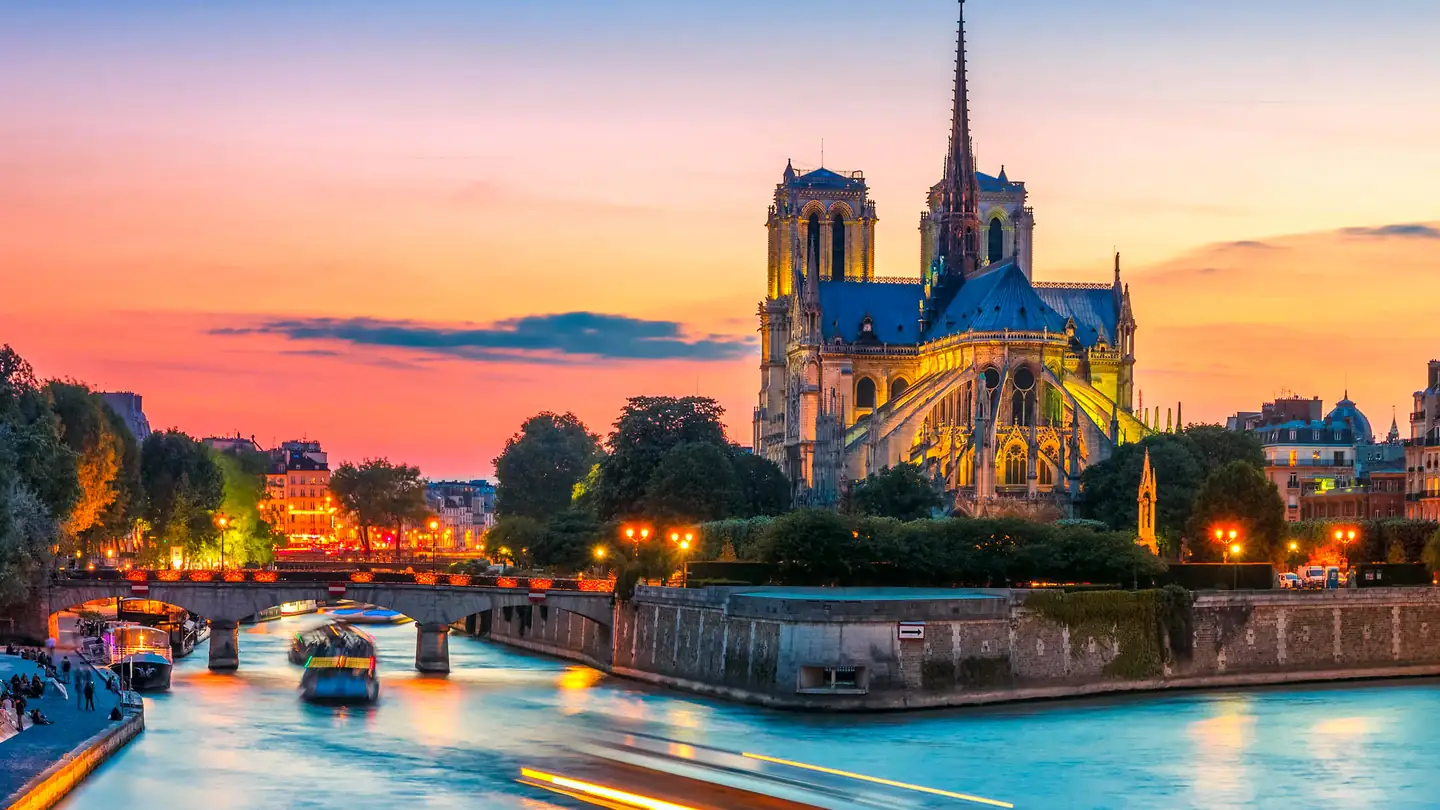
Free entry, a free timed slot, the quietest hours, the scams to ignore — and exactly what to do once you are inside.
Two lines form on the square in front of the cathedral. One moves in five minutes. The other stands in the sun for ninety. The only difference between them is a free booking made two days earlier on a phone.
That is the single most useful thing to know before you visit Notre-Dame de Paris. Since the cathedral reopened on December 8, 2024 — five years and eight months after the fire — entry is free for everyone, there is no ticket to buy, and a free timed reservation is what separates a calm morning from a wasted afternoon.
Below: how to book, opening hours, the metro, the security check, the dress code, the street scams to ignore, and exactly what happens once you step inside. For the full history and everything to see, our Ultimate Guide to Notre-Dame de Paris is the companion piece; this one is pure logistics.
Let's clear up the most common confusion first. Notre-Dame free entry is real. The cathedral has never charged admission, and it does not now. Anyone on the square telling you otherwise is trying to sell you something you don't need — more on that below.
What changed after the reopening is the volume, not the price. The cathedral now draws around 40,000 visitors a day. To keep the crush from becoming a crowd-crush, it introduced free timed slots. You pick a date and a window, you get a confirmation on your phone, and you enter through a dedicated lane while the walk-in line waits.
Here's how to lock one in:
One honest caveat: in high season, slots for the coming days get taken quickly. If they're gone, you're not locked out — you can still walk in. Just plan around the clock instead (next section).
The published hours are: Monday to Friday 7:50am–7:00pm, Thursday until 10:00pm, and weekends 8:15am–7:30pm, with last entry 30 minutes before closing. Treat these as a guide and confirm on the official site before you go, because mass times and feast days shift access without much warning.
Now the part the hours table won't tell you: the building fills and empties in a predictable rhythm.
The first ninety minutes after opening are the prize. On a weekday between 7:50 and 9:30am, the coach groups haven't arrived, the light comes in low, and you can hear your own footsteps.
Thursday evening is the other secret window. Few people think to visit a cathedral after dinner, so 7 to 10pm can feel almost private.
The stampede runs 10am to 4pm. If that's your only option, book a slot and accept the company.
A tip travelers learn the hard way: there are no public toilets inside the cathedral, and you cannot leave and re-enter on the same reservation. The public restrooms sit under the square, near the entrance to the Archaeological Crypt. Go before you queue, not after.
Notre-Dame stands on the Île de la Cité, the island in the middle of the Seine that is, quite literally, the cradle of Paris — the Romans built their town here and called it Lutetia. The address is 6 Parvis Notre-Dame – Pl. Jean-Paul II, 75004 Paris, and it is one of the best-connected spots in the city.
One local piece of advice from the audio tour: don't get off at Châtelet. It's close on the map, but its underground passages confuse even Parisians. And if you're arriving with a stroller or a wheelchair, skip the steps of the central portal — there's a step-free entrance with a ramp on the left side of the main facade.
You don't have to take the metro at all. Notre-Dame is a short walk from most of the historic center: about 25 minutes on foot from the Louvre, under 5 minutes from Sainte-Chapelle, roughly 10 minutes from the Latin Quarter, and just a few minutes from the Île Saint-Louis across the bridge.
If you're spending the day in the old center, it makes far more sense to chain Notre-Dame together with the Île de la Cité, Sainte-Chapelle, the Conciergerie and the Latin Quarter on foot than to hop between separate metro rides. The whole island is walkable end to end in fifteen minutes.
Small-group and private tours of Notre-Dame and the Île de la Cité — skip the planning and let a local lead.
Before the doors, there's a security check, and it moves fast if you've packed light. Large bags and backpacks are not allowed, and there is no cloakroom inside to stash them — so leave the big rucksack at your hotel. Bags get checked; tripods and flash are prohibited.
The dress code is enforced at the door, reservation or not. The cathedral's own rule: shoulders, torso, midriff and knees covered — no sleeveless tops, shorts, or miniskirts, and nothing tight or see-through. Men are asked to remove hats and caps inside. Guards genuinely turn people away for bare shoulders, even those holding a valid slot. In warm weather the fix is simple: carry a light scarf or shawl in your bag and drape it over your shoulders as you approach. It weighs nothing and saves the whole visit.
And remember what this place is. Notre-Dame is not a museum; it's an active cathedral with daily masses — weekdays at 8:00, 12:00 and 18:00; Saturday at 8:30, 12:00 and 18:00; Sunday at 8:30, 10:00 (Gregorian chant), 11:30 and 18:00. Twenty minutes before a service, a separate line opens for those coming to pray — no reservation needed for that.
The people kneeling in the pews around you are praying, not posing. Keep your voice to a whisper — staff periodically ask over a microphone for "Silence, s'il vous plaît." During a service, tourists still move through, but only along the side aisles, and photographing people mid-prayer earns a firm word from the wardens.
Movement inside runs one way, on a set route: in through the central Last Judgment portal, past the font, around the choir toward the altar and the light, and out. Miss a chapel and, at peak times, you can't double back — you loop again.
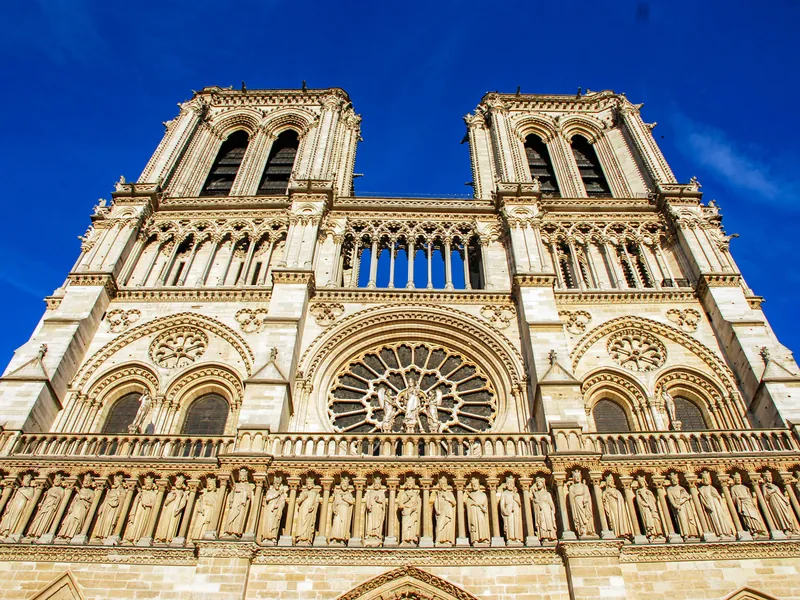
Pause under that central portal for a moment before you go in. It's a carving of the Last Judgment, the saved on Christ's left and the damned dragged off to his right. For centuries, worshippers entered through the right-hand door — the sinner's door — and left through the left, symbolically cleansing themselves on the way through. The route has changed, but the stone hasn't.
If your goal is simply to see the cathedral from the inside, 20–30 minutes is usually enough.
Most visitors, though, spend about an hour: taking in the windows, walking the chapels, listening to the organ, sitting for a few quiet minutes.
And if you plan to climb the towers, visit the crypt and walk the Île de la Cité with an audio tour, give yourself at least three hours.
Because entry is free, a small industry has grown up trying to make you forget that. On the square you may meet two kinds of hustle. The first is the petition clipboard: someone approaches, asks you to sign for a good cause, and while you're focused on the paper, a partner works your pockets. The second is a person selling "Notre-Dame tickets."
There is no such thing. You never pay to enter Notre-Dame, and no legitimate cathedral ticket is ever sold on the street.
The cathedral also warns about a subtler trick: some platforms and agencies book the free slots, then resell them at a markup. Those "tickets" carry no weight and grant no right of entry. The only valid reservation comes from the official site.
The only real tickets nearby are for the towers, the crypt, and the treasury — and those come from their official channels, never from a stranger with a lanyard. Pickpockets favor the crowds around major sights, so wear your bag on the front.
You know the logistics now. Next you need the stories.
The self-guided TouringBee audio tour of Notre-Dame de Paris and the Île de la Cité turns a walk-through into two hours of legends: the beheaded stone kings whose real heads turned up under a Paris mansion in 1977, the devil said to have forged the iron doors, and why only one king was ever crowned here — a ten-year-old English boy.
It's 31 stops, 10 languages, 100% offline — an offline GPS map shows where you are, and you start each track yourself at the spot. From €9.99, one payment, one year of access, on iOS and Android.
The cathedral itself — the nave, the three rose windows, the chapels, the carved choir screen, the great organ, the salvaged copper rooster from the spire now displayed inside with its dents and fire scars still visible — all of it is free. You don't need a ticket for any of it.
What's paid is separate, and none of it is required to see the cathedral:
When you can see the Crown of Thorns: it's brought out every Friday from 3:00 to 6:30pm, with an adoration on the first Friday of the month from 3:00 to 5:00pm. That's free, and it happens inside the cathedral itself.
Which of these is worth your time and euros is its own question — we lay it all out in the dedicated Notre-Dame tickets guide.
Timed tickets for the Archaeological Crypt and Sainte-Chapelle a few steps away — booked ahead, skip the ticket line.
Here's a realistic hour, assuming a morning slot.
–20 min — On the square (Place Jean-Paul II). Arrive early and use the underground toilets by the Archaeological Crypt now. This square is also where the TouringBee audio tour begins, so press play here and let the exterior stories unfold before you go in. Find the copper octagon set in the pavement — Point Zéro, the point from which every distance in France is measured. Tradition says you stand on it, make a wish, and jump while spinning clockwise.
–10 min — Read the facade. Look up at the Gallery of Kings, the row of 28 statues — Revolutionaries beheaded the originals, mistaking these biblical kings of Judah for French monarchs. Then find the central portal's Last Judgment above the doors.
0 min — Security and the doors. Scarf over shoulders, small bag ready. Through the check, past the great wrought-iron hinges legend credits to a blacksmith who supposedly struck a bargain with the devil, and inside.
+2 min — The nave. Stop. The word nave comes from the Latin for "ship" — look up and the vaulting really does read like an upturned hull. The cleaned limestone glows pale gold now, not the soot-black church Mark Twain once described.
+10 min — Around the choir. Follow the ambulatory past the fourteenth-century carved choir screen, the oldest fresco, and the salvaged rooster exhibit — get close to the case to see the dents from its 96-meter fall. Don't stop dead in the narrow passages; there are wider spots by the chapel windows for photos.
+25 min — The transept and roses. The two great rose windows here are far bigger than the one over the entrance — 13 meters across, their deep blue drawn from lapis lazuli mined in Afghanistan. On a sunny day between about 11:30 and 1:30, the south rose throws a carpet of colored light across the stone floor.
+35 min — The organ and the exit. Near the entrance end sits the great organ: over 8,000 pipes, the largest in France. Its organist Louis Vierne died at the keyboard mid-concert in 1937.
After — Don't eat on the square. The cafés right on the Parvis and Rue d'Arcole charge 30–50% more for less. Cross the Pont Saint-Louis to the Île Saint-Louis (300 meters) for real bakeries and Berthillon ice cream, and pause on the bridge, where street musicians often play with the apse behind them.
If you've got a couple of hours left after the cathedral, don't rush off — the best of medieval Paris is within a five-minute walk.
Sainte-Chapelle, five minutes away, holds some of the finest stained glass in the world: fifteen soaring windows of mostly original thirteenth-century glass. The Conciergerie next door is a former royal palace turned Revolutionary prison, where Marie-Antoinette was held before her execution. Across the bridge, the Île Saint-Louis is all quiet cafés, bakeries and that famous Berthillon ice cream. And a few minutes the other way across the Seine puts you in the heart of the Latin Quarter — which happens to have its own TouringBee audio tour.
Hotels and apartments on the Île Saint-Louis and the Left Bank put Notre-Dame a five-minute stroll from your door.
If you can pick only one time to visit Notre-Dame, come on a weekday morning, right after opening. That's when the cathedral is at its most powerful: quiet inside, the light falling cleanly through the windows, and the queues yet to build.
And if a morning is impossible, at least secure the free reservation. It costs nothing and can save you a few hours of waiting.
Entry is free, the reservation is free, and the quietest hour is a weekday morning. You've got the logistics — now get the stories. Let old Etienne, the cathedral's gargoyle-maker, walk you from Point Zéro to the great organ across 31 stops of legend and history, offline and in your language.
Start the audio tour — from €9.99Some links are partner links (Tiqets, GetYourGuide, Headout, Booking.com). The price is the same for you; we may earn a small commission.
