
The cathedral is free — no ticket exists. Here's what you really pay for: the towers, the crypt, the treasury and the Crown of Thorns, with 2026 prices and hours.
Here's the thing almost nobody tells you before they fly to Paris: you do not need a ticket to walk into Notre-Dame de Paris. Entry to the cathedral is free. It always has been. It's a working church, not a museum.
So why do thousands of people search for Notre-Dame tickets every month? Because "Notre-Dame" is really four different places stacked on one island, and only some of them cost money. The confusion is understandable — and the people selling laminated "skip-the-line cathedral tickets" on the square are counting on it.
Below: what's free, what's paid, what it actually costs, and where to buy the real thing. For the full history and story of the cathedral itself, see our Ultimate Guide to Notre-Dame de Paris. This page is the practical stuff — money, doors, and steps.
Let's settle this first, because it changes how you plan the whole day.
Notre-Dame de Paris reopened on December 8, 2024, five years after the 2019 fire. Admission costs nothing. Anyone can walk in, sit in a pew, look up at the vaults, and walk out without paying a euro.
What you can reserve for free is a timed entry slot. You do it at resa.notredamedeparis.fr or in the official Notre-Dame app. Slots usually open close to the visit — two days ahead, one day ahead, or same day. It's not a paid ticket; it's a way to skip the general queue. In summer the walk-in line runs from thirty minutes to three hours, and a free slot removes most of that wait. You can still walk in without one — it's just a gamble.
When people say "Notre-Dame tickets," they usually mean one of four things:
Each gets its own section below, with the story that makes it worth the money.
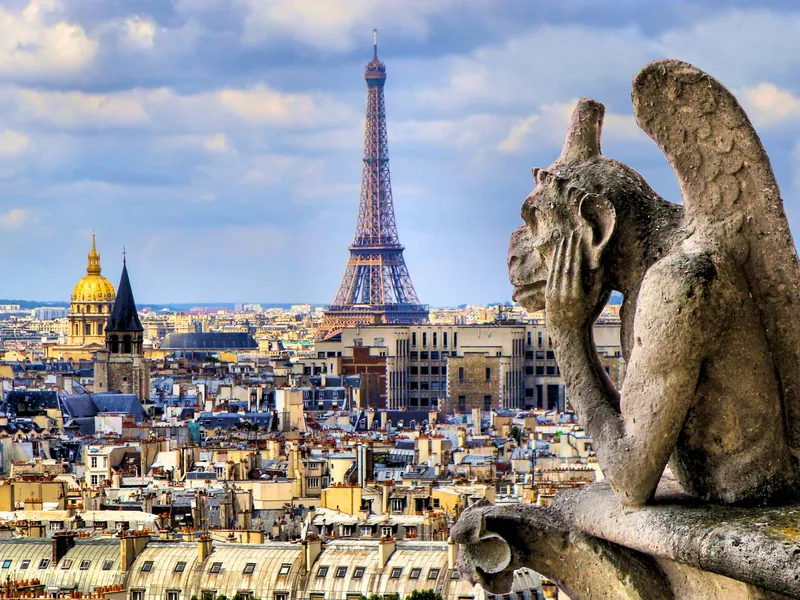
If you climb one thing in Paris, climb this. At the top, the cathedral stops being a postcard.
An adult tower ticket is €16, and booking is mandatory. There are no on-site sales at all — only a timed e-ticket at tours-notre-dame-de-paris.fr, run by the CMN (the national monuments body). No one gets in without a reservation.
Important: the free and reduced categories still have to book a slot in advance. Free entry goes to under-18s, EU citizens and permanent French residents aged 18–25, visitors with a disability plus one companion, and everyone on the first Sunday of January, February, March, November and December. Only a limited number of free places are released per slot — once the quota is gone, only paid tickets remain.
Hours: April 1–September 30, 9:00am–11:00pm; October 1–March 31, 9:00am–5:30pm. Last entry one hour before closing. Closed January 1, May 1 and December 25. In extreme heat or bad weather the climb can close — if it does, your e-ticket is refunded automatically.
Now the reason to do it. The climb is 424 steps and 69 meters, with passages that pinch to 45 centimeters and spots where you duck. There is no lift, no water and no toilet on the route, and you get five minutes at the top.
On the gallery that bridges the two towers you meet Stryge — a chimera perched on the parapet, chin on her hands, tongue out at the city. She looks medieval. She isn't. The architect Viollet-le-Duc invented her during the 19th-century restoration, purely for effect, and in 1853 an engraver named Charles Meryon put her in a print. She became one of the most photographed carvings in Paris. She has no gutter and no job — nothing to do but brood over the rooftops. Stand next to her and the question of whether the climb was worth it answers itself.
From up here you also get the view Quasimodo had. Victor Hugo set his hunchbacked bell-ringer in these towers, and it was his 1831 novel that shamed Paris into saving the cathedral.
Most visitors walk right past it. There's a stairway down on the big square in front of the cathedral, and beneath it lies two thousand years of Paris.
The Archaeological Crypt of the Île de la Cité (Crypte archéologique de l'Île de la Cité) belongs to the City of Paris museums. A full ticket is €11, reduced €9, and under-18s go free. It's open Tuesday to Sunday 10:00am–6:00pm, ticket desk closing at 5:30pm; closed Monday, plus January 1, May 1 and December 25. Entry is included in the Paris Museum Pass. (Note: the crypt is currently closed for restoration, so check before you go.)
Down there you walk among the stone foundations of the city the Romans built here — houses, a heating system, a quay wall. These are the remains of Lutetia.
That was the town's original name: Lutetia Parisiorum, from the Latin lutum, meaning mud or swamp. The Romans took the island in the first century BCE, found a marshy river fortress the Gauls called home, and — not overly impressed — named it after the mud. It grew anyway: stone houses, temples and baths, and eventually Paris. The crypt is the only place you can stand inside that lost city. Twenty minutes, cool and quiet, and almost never a queue.
Of all the paid corners of Notre-Dame, the Treasury holds the object with the most outrageous backstory.
The Treasury (Trésor) costs €12 full and €6 reduced — for under-18s, students and the unemployed with ID. Under-5s, clergy, ICOM and ICOMOS card holders, and visitors with a disability plus companion enter free. Tickets are sold on-site only, at the Treasury desk; there is no online booking. You reach it from inside the cathedral, through the south choir ambulatory, in the sacristy area.
Hours: Monday–Saturday 9:00am–6:00pm (Thursdays until 8:30pm), Sunday 1:00–5:30pm. Last entry 30 minutes before closing.
Here is where the Crown of Thorns is kept — and here is what it cost France.
In the 13th century the relic was in Constantinople, until the crusader-emperor Baldwin II, drowning in debt, pawned it to Venetian bankers. When the French king Louis IX heard that the Crown of Christ had been put up as loan collateral, he decided to have it at any price. Negotiations took two years. The final figure was staggering — roughly half of France's entire annual budget (something like €5.5 million in today's money). In 1239, the crown came to France.
Then Louis did something no treasurer would advise. When the relic reached the town of Sens, the king and his brother Robert stripped to plain shirts, took off their shoes, and carried the reliquary barefoot, taking turns over some 24 kilometers of road. A king who had just spent half his kingdom's budget, walking the dust without shoes. His subjects were stunned. Louis later built Sainte-Chapelle specifically to house the crown, and was himself made a saint.
The Crown of Thorns stayed in Sainte-Chapelle until the Revolution, then moved to Notre-Dame. It survived the 2019 fire — carried out as the roof burned.
When you can see it: the crown is brought out every Friday from 3:00 to 6:30pm, with an adoration on the first Friday of the month from 3:00 to 5:00pm. That part is free, and it happens inside the cathedral itself.
You know the logistics now. Next you need the stories.
The self-guided TouringBee audio tour of Notre-Dame de Paris and the Île de la Cité is 31 stops across about two hours: Stryge on the towers, Roman Lutetia under the square, Louis IX and the Crown of Thorns, the fire, the chimeras, the coronations. An offline GPS map shows where you are, and you start each track yourself at the spot.
Since you're already on the Île de la Cité, the obvious pairing is Sainte-Chapelle — the very chapel Louis IX built for the Crown of Thorns now sitting in Notre-Dame's Treasury. Its upper level is fifteen meters of near-continuous stained glass. It's a five-minute walk, and it does need a paid, timed ticket.
We link to booking partners because it's the simplest way to lock in a time before you travel. You can book Sainte-Chapelle and the Archaeological Crypt through Tiqets, a guided cathedral or island walk through GetYourGuide, and browse other Paris experiences on Headout. All of it is optional. We earn a small commission, the price is the same for you, and none of it is needed to enter the cathedral.
Small-group and private tours of Notre-Dame and the Île de la Cité — a live guide instead of guesswork.
Timed tickets for Sainte-Chapelle and the Archaeological Crypt, five minutes away — booked ahead, straight past the ticket line.
Now the warning. On the square in front of the cathedral, people will approach you with a clipboard and a "petition," and others will sell you "Notre-Dame tickets" or a "skip-the-line pass." Don't engage. The petition is a distraction while a partner works your pockets, and the cathedral tickets are fake, because entry is free.
The cathedral also warns about a subtler trick: some platforms and agencies book the free slots, then resell them at a markup. Those "tickets" grant no right of entry.
Pickpockets have worked this square since the Middle Ages. Wear your bag on the front and keep your wallet in an inside pocket. Real paid tickets come in only four kinds: the towers (online only), the crypt (at the crypt desk or a trusted partner), the treasury (inside the cathedral), and Sainte-Chapelle.
Now you know what's free, what's paid and what someone's trying to slip past you. The last piece is the stories — a €16 tower ticket buys the view, but not the tale of the monster waiting at the top. Bring Etienne along: the TouringBee audio tour gives you all 31 stops, offline and in your language, from €9.99 with a full year of access.
Start the audio tour — from €9.99Some links are partner links (Tiqets, GetYourGuide, Headout). The price is the same for you; we may earn a small commission.
