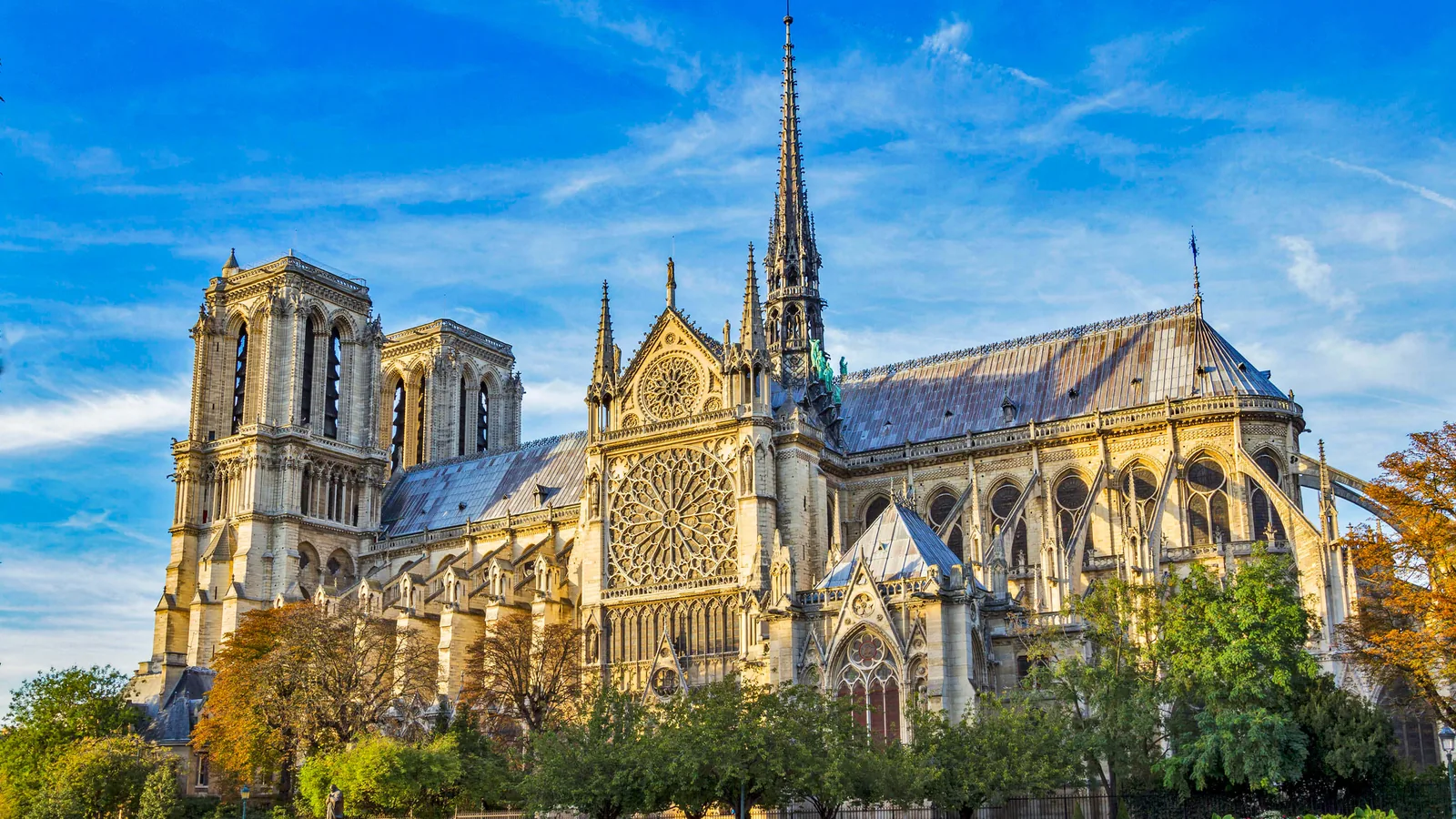
The evening it nearly ended, the hour that saved it, what was lost, what survived by luck and timing, and how Paris rebuilt the cathedral in exactly five years.
On the evening of April 15, 2019, the world watched a livestream it could not believe. Flames poured through the roof of Notre-Dame de Paris, the spire tilted, and at 7:50pm it folded into the fire and vanished. For a few hours it genuinely looked as if the cathedral that had stood for more than 850 years was going to be gone by morning.
It wasn't. By dawn the two great towers still stood, the stone vault had held, and most of what makes Notre-Dame Notre-Dame had survived — some of it by luck, some of it by a decision made days earlier, and a lot of it because of one hour of firefighting that almost no one saw.
This is the story of what actually happened that night, what was lost, what survived, and how France restored and reopened the cathedral. If you'd rather hear it on the spot, the TouringBee audio guide begins the story right in front of the facade and then takes you inside: 31 stops, about two hours, fully offline.
The first warning came in the middle of an evening Mass. At about 6:20pm a fire alarm sounded, the congregation was calmly moved out, and staff went looking for the source — and found nothing. The system pointed them to the wrong place, and for more than twenty minutes the fire burned unseen in the timber attic above the stone ceiling.
At 6:43pm the alarm sounded a second time. This time the smoke was unmistakable. Firefighters were called and arrived within minutes, but by then the blaze had taken hold of the roof — the one part of Notre-Dame built almost entirely of wood, and the hardest part to reach. Those lost early minutes are the reason the roof could not be saved.
Here is the thing most people watching that night didn't understand: Notre-Dame is really two buildings stacked together. The part that burned — the roof and spire — sat on top of a second ceiling, the stone vault, which is the curved stonework you see when you look up inside.
That vault is what saved the cathedral. As the roof collapsed, it rained burning timber and, eventually, the 750-tonne spire straight down — and the stone vault caught most of it, like a shield held over the interior. A few sections punched through, but the vault held. Had it collapsed over a much larger area, the damage to the interior, the organ and the art would have been far worse. The difference between a damaged cathedral and a lost one was, in large part, those few metres of medieval masonry doing exactly what they were built to do.
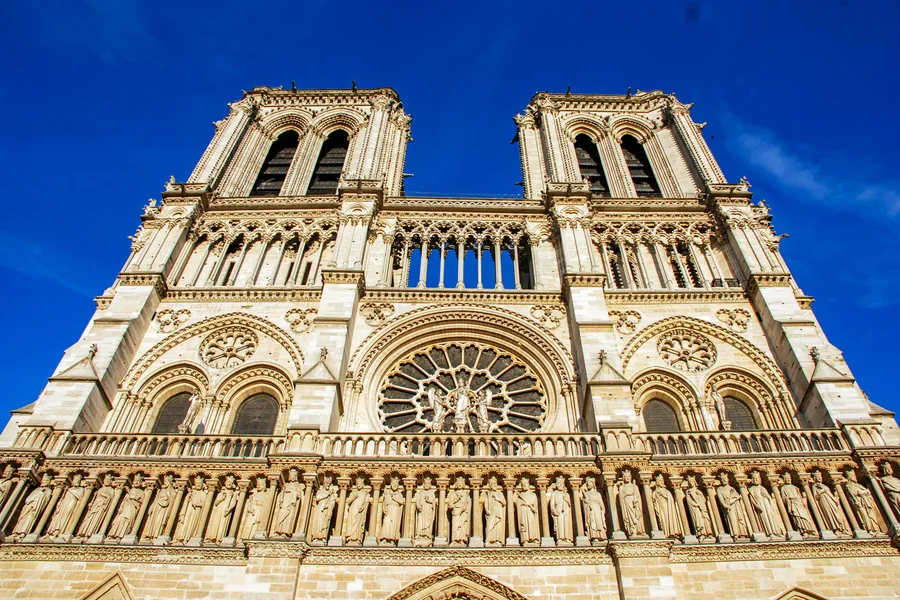
The real battle that night wasn't the spire. It was the north tower. Fire had spread to the timber framing at the base of the belfry, beneath the great bells. The firefighters understood that if the north tower collapsed it could bring down the south tower too — and a tower falling into the body of the cathedral is the scenario that ends everything.
A team went up into the burning tower to stop it, and they succeeded. It helped that they knew the building from the inside: only the previous autumn, a few months before the fire, Paris firefighters had run exercises inside Notre-Dame itself and were familiar with its layout. Down below, meanwhile, firefighters and clergy formed a human chain to carry out relics and artworks while the roof burned overhead. The cathedral was saved less by luck than by people who had, improbably, prepared for the worst night of its life.
The single biggest loss has a name: la forêt, "the Forest." Above the stone vault, Notre-Dame's roof was carried on a dense lattice of oak beams first assembled in the 12th and 13th centuries — hundreds of individual trees, many of them already old when they were felled around 1160–1170. Standing in that attic was like standing inside a forest turned upside down. Once the fire took hold, it spread quickly through that vast web of timber running the length of the cathedral.
The spire went with it. That spire was not medieval — it was designed in the 19th century by the architect Eugène Viollet-le-Duc, added during his famous restoration, and it had become one of the most recognised silhouettes in Paris. When it fell, it fell into the very fire that had started nearby.
For all the devastation above, the losses inside were far smaller than that night suggested. The three rose windows — the oldest glass dating to the 13th century — came through intact. The great organ, nearly 8,000 pipes, didn't burn, though it was later painstakingly cleaned of toxic dust. The Crown of Thorns and the other great relics were carried to safety. The main altar and cross survived beneath the collapse.
And then there is the detail that sounds invented: the 16 copper statues of the apostles and evangelists that ringed the base of the spire were not there when it fell. Just four days before the fire, they had been craned off the roof and sent away for cleaning as part of the restoration already under way. One of them, the apostle Thomas — the patron saint of architects — had been cast with the face of Viollet-le-Duc himself, gazing up at his own spire. By pure chance, they all escaped.
€9.99 €6.99 — an exclusive discount for readers of this site. It's applied automatically at checkout: no code, nothing to enter. One payment, a full year of access in your language.
Download link sent to your email right after purchase · the guide works for 1 year · questions? support@touringbee.com
Buy the Audio Guide — €6.99Notre-Dame audio guide: route, stops & what's inside →
At the very top of the lost spire sat a copper rooster — the weathervane, a symbol of France, and also a tiny reliquary: sealed inside were a fragment of the Crown of Thorns and relics of Saint Denis and Saint Genevieve, the patron saints of Paris.
When the spire collapsed, the rooster disappeared into the debris and was feared lost. Days later it was found in the rubble — battered but intact, with the relics still safe inside. A new golden rooster now crowns the rebuilt spire, while the original is on display in the Cité de l'Architecture et du Patrimoine museum in Paris. For a lot of Parisians that dented little bird became the image of the whole story: knocked out of the sky, given up for lost, and then recovered.
On the spot, these details line up differently: the TouringBee audio guide shows you where the old spire stood, where the rescued statues used to be, and exactly what changed in the restoration. →
Notre-Dame's roof and spire were covered in lead — more than 400 tonnes of it. In the heat of the fire a large amount of it melted, and the blaze scattered lead dust and particles across the cathedral and the surrounding streets. That turned the cleanup into a decontamination operation as well: the site was sealed, cleaned, and nearby schools were checked, and it slowed the first phase of work considerably. It's the part of the disaster that didn't make the dramatic footage but shaped the two years that followed.
Within days, a very modern argument broke out. Should Notre-Dame be rebuilt exactly as it was, or should the 21st century leave its mark? Architects around the world floated bold ideas: a roof of glass, a rooftop garden, even a beam of light where the spire had stood. Macron himself initially suggested room for a contemporary gesture. For a moment it was genuinely unclear which way France would go.
After public and professional debate — and with heritage defenders and the Senate pushing hard for it — the choice was to rebuild à l'identique, identically. The spire rose again to Viollet-le-Duc's 19th-century design, and the roof's Forest was remade in oak, as in the Middle Ages. The one visible concession to the present was a set of new stained-glass windows by contemporary artists.
Two days after the fire, President Emmanuel Macron promised to rebuild the cathedral within five years — ideally in time for the 2024 Paris Olympics. It was a deadline almost every expert quietly thought impossible. Money arrived almost immediately: donations came to around €840–846 million from roughly 340,000 donors across some 150 countries, from large gifts by French families to small sums sent from the other side of the world. The works to reopen cost on the order of €700 million; the surplus went to continued restoration.
Rebuilding the Forest meant going back to the land. Around 2,000 oak trees were selected from forests across France — some of them centuries old — and worked, in part, with traditional methods and hand tools so that the new frame matched the old. The spire was reassembled piece by piece behind scaffolding and crowned, once again, with a golden rooster carrying the city's relics. Stone was cleaned, vaults repaired, the organ rebuilt pipe by pipe.
Notre-Dame reopened on December 7 and 8, 2024 — shortly after the summer Olympics, and five years and nearly eight months after the fire. Heads of state and tens of thousands of onlookers watched the great doors open and the rebuilt organ sound again for the first time.
What journalists and visitors noticed first wasn't the new roof they couldn't see — it was the light. Centuries of soot, candle smoke and grime had been cleaned from the stone, and the interior turned out markedly brighter than modern visitors were used to. In a strange sense the fire gave Notre-Dame back a brightness it had lost generations ago. Work on the exterior, the flying buttresses and the forecourt continues, and is expected to run to around 2027.
Small-group and private Notre-Dame and Île de la Cité tours — the fire, the rebuild and the stories, with a guide instead of guesswork.
Mostly, no — and that's the point. The spire overhead is brand-new but identical to the one that fell. The stone is cleaner than before. The Forest is back above the vault, invisible to visitors as it always was. If you look closely you can still find fresher, paler stone where repairs were made. The original rooster that survived the fire is not in the cathedral but in the Cité de l'Architecture et du Patrimoine museum. But the overwhelming impression inside is not of damage — it's of a building that came back brighter than it left.
Entry to the cathedral is free, and a free timed reservation is strongly recommended. If you end up waiting to get in, you can start the walk outside — some TouringBee stops are on the square in front of the cathedral — and carry on inside after security; if you're asked to take your headphones off at the entrance, you can put them back on once you're through. And to understand what you're looking at — which stone is new, where the spire stood, what the vault did that night — that context is exactly what an audio guide is for.
Stay a short walk from the Île de la Cité and you can be first through the doors in the morning, before the crowd.
When did Notre-Dame burn down?
Notre-Dame did not burn down — it was badly damaged but survived. The fire broke out on the evening of April 15, 2019, and was brought under control that same night.
What caused the Notre-Dame fire?
The cause was never officially established. Investigators treated it as accidental; the possibilities raised were an electrical fault and a cigarette, with restoration scaffolding on the spire at the time. No criminal intent was found.
What was destroyed, and what survived?
The 19th-century spire and nearly all of the medieval oak roof ("the Forest") were destroyed. The towers, stone vaults, three rose windows, the great organ, the Crown of Thorns and the relics all survived, as did 16 statues removed from the spire days before the fire.
Is Notre-Dame open again?
Yes. The cathedral reopened on December 8, 2024, five years and nearly eight months after the fire. Entry is free; a free timed reservation is recommended. Work on parts of the exterior and surroundings continues to around 2027.
How much did the restoration cost, and who paid?
Donations came to roughly €840–846 million from about 340,000 donors in 150 countries. The works to reopen cost on the order of €700 million, with the surplus going to continued restoration. Entry to the cathedral itself is free.
Was the spire rebuilt the same, or changed?
The same. After a public debate about a modern design, France chose to rebuild "à l'identique," so the new spire matches Viollet-le-Duc's 19th-century design. The one visible modern touch is a set of new stained-glass windows.
Can you tell there was a fire when you visit?
Barely. The restoration was deliberately faithful, so the main impression inside is unusually bright, clean stone. The original rooster that survived the fire is displayed not in the cathedral but in the Cité de l'Architecture et du Patrimoine museum.
Notre-Dame came closer to being lost than most people realise — and came back brighter than it left. When you stand inside, the best way to understand what you're seeing, where the spire stood and what the vault did that night is to have the stories in your ear: 31 stops, ~2 hours, 10 languages, fully offline, one year of access.
Start the audio guide — from €6.99Some links are partner links (Booking.com, Tiqets, GetYourGuide). The price is the same for you; we may earn a small commission.
