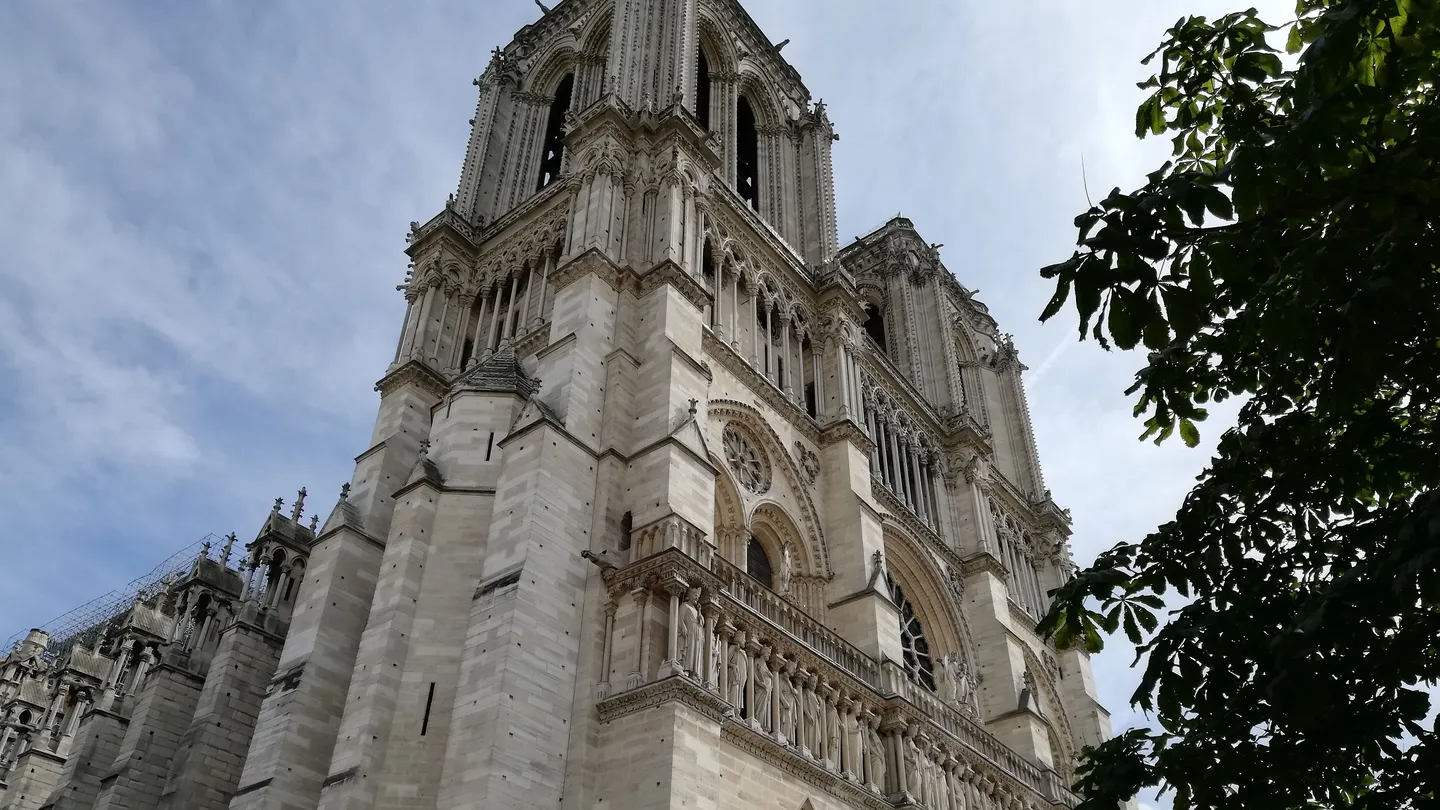
The new post-fire route, booking, prices and hours for 2026 — plus the stories that make the climb worth it: the bell that survived the Revolution, Viollet-le-Duc's chimeras and the word on a wall that gave rise to Hugo's novel.
Notre-Dame's towers reopened on 20 September 2025. After the fire, the route was laid out from scratch: a new oak staircase now takes you up, you pass the bells almost within arm's reach, and openings in the stone give you a look at the freshly rebuilt timber roof over the nave. From the top you see the Seine, the islands and the whole of central Paris — and in summer the towers stay open until 11pm, so you can even climb for sunset.
Below is everything you need to know before you go up: how to book, what it costs, what you'll see on the way and who's better off skipping the climb. Plus a few stories that make those 424 steps worth climbing at least once in your life.
Tip: tower slots are timed, and you'll often have half an hour to an hour to kill before yours. That's a good moment to explore the square with the TouringBee audio guide: 13 of its 31 stops are outside, some of them right by the towers.
| Price | From €16; free for under-18s, EU residents aged 18–25 and some other concessions |
| Booking | Online only, on the official website; a timed slot is required — even with a free ticket |
| Hours | April–September 9am–11pm, November–March 9am–5:30pm (check October hours on the official website); last entry one hour before closing |
| Duration | About 50 minutes |
| The climb | 424 steps, top terrace at 69 m; no lift |
| Entrance | At the foot of the south tower (on the right as you face the façade) |
| Not suitable for | People with heart conditions or a fear of heights, pregnant women, young children; no toilets or water |
There's no ticket office at the towers. Tickets are sold only online, on the official website of the Centre des monuments nationaux (CMN), with a set entry time. That goes for everyone: those who pay and those who go free — under-18s, EU residents aged 18 to 25, disabled visitors and their companion, and Paris Museum Pass holders. Everyone needs their own e-ticket, children included. One booking covers up to seven people.
Summer evenings and weekends get snapped up early, so book as soon as you know your date. And be careful when you search: the results are full of sites selling "skip-the-line" tower tickets at inflated prices. There's no walk-up queue to skip here in the first place — only a slot on the official website. For more on what you actually have to pay for at Notre-Dame, see our tickets guide.
If the towers close because of bad weather, your e-ticket is refunded automatically.
The entrance is at the foot of the south tower. The first hall holds models of the cathedral and its façade, and next to them, two original chimeras taken down from the building. You rarely get to see them this close: the Dog-Headed Woman (La Femme à tête de chien) and the Creature Baring Its Teeth (La Créature montrant ses crocs). In the neighbouring salle des Quadrilobes, a sound installation plays: bells recreate four moments in the history of Paris — the first Estates General in 1302, the celebrations of Louis XIV, Napoleon's coronation and the liberation of the city in 1944.
Then comes the star of the new route: a huge double-helix spiral staircase in oak — 178 steps, about 21 metres high and weighing almost 20 tonnes. It was designed by the restoration's chief architect, Philippe Villeneuve, and assembled inside the south tower in 2025. The way up and the way down follow separate spirals, so the two streams of visitors never meet. The rest of the route is narrow medieval stone stairs.
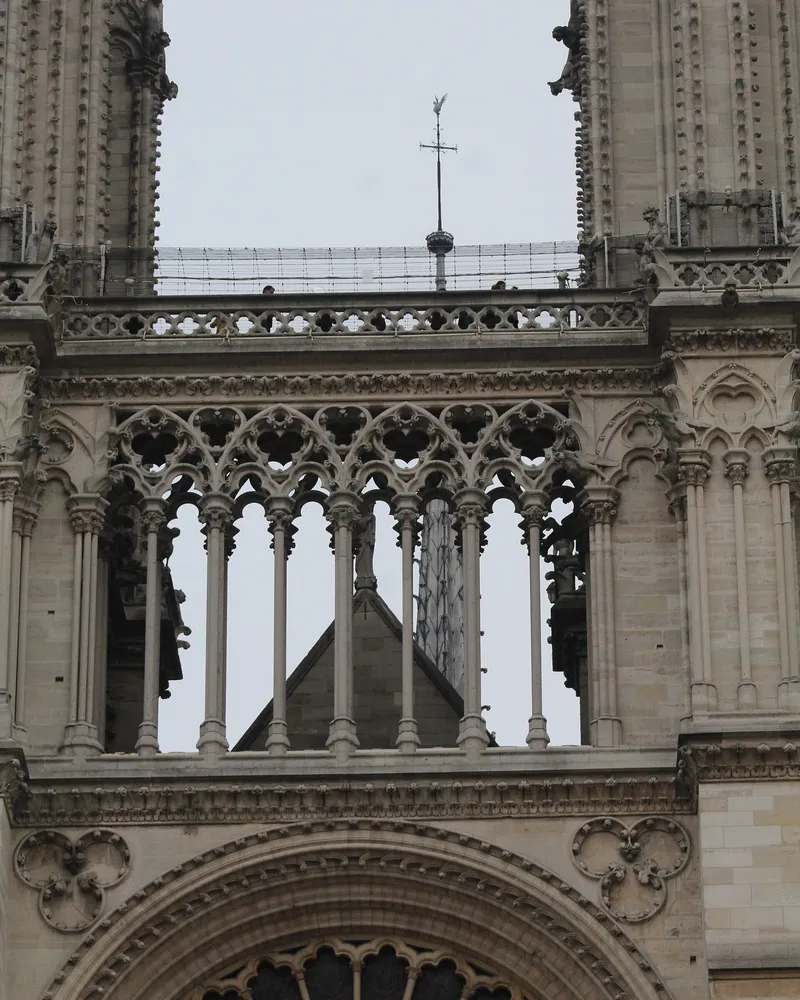
Along the way you pass the great bells, step out onto the galerie des chimères between the towers and look into "the Forest" — the rebuilt oak roof over the nave. You come down through the north tower to a soundscape composed especially for the route.
Important: backpacks and bags larger than 40 × 40 × 20 cm, pushchairs, scooters, tripods and selfie sticks aren't allowed up, and there's no left-luggage office.
Few people know that you don't have to go all the way to the top. The final stretch to the terrace on the south tower is 123 steps up a very narrow, steep staircase — just 45 centimetres wide in places — and you come back down the same way. If you're tired or afraid of heights, you can skip it: the view from the galerie des chimères, about 46 metres up, is already breathtaking.
But if you've got the energy, keep going. At 69 metres you get a 360-degree panorama, with orientation tables to tell you what you're looking at. In high season the terrace can get crowded, and time at the top may be limited.
Download link sent to your email right after purchase · the guide works for 1 year · questions? support@touringbee.com
Get the Audio Guide — €6.99Notre-Dame audio guide: route, stops & what's inside →Two great bells hang in the south tower. The elder, Emmanuel, weighs more than 13 tonnes and was cast in 1686 under Louis XIV. During the Revolution, Notre-Dame's bells were melted down for cannons and coins, and Emmanuel was the only one to survive. It was Emmanuel that rang out on the evening of 24 August 1944, as the first units of Leclerc's division entered Paris. We've gathered this and other stories in our article on the cathedral's history.
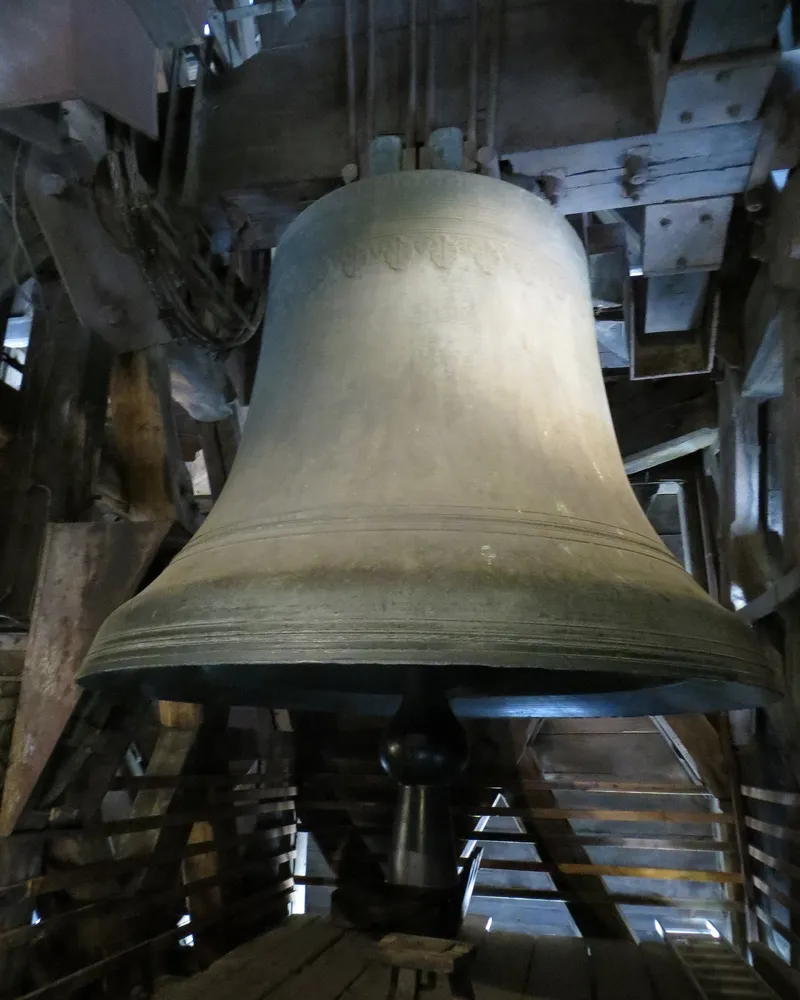
Beside it hangs Marie, weighing about six tonnes. She has quite a story too. Notre-Dame already had a bell of that name in the Middle Ages, and in Hugo's novel it was Quasimodo's favourite. The Revolution destroyed it, and a new Marie wasn't cast until 2012, for the cathedral's 850th anniversary. So the bell-ringer from the novel would find his bell waiting for him today.
The north tower holds eight more bells, cast in 2013. They were taken down after the fire and returned in September 2024. The timber frame that Emmanuel swings in was rebuilt, and in summer 2025 the great bell began to swing again. On the route you get almost right up to the bells.
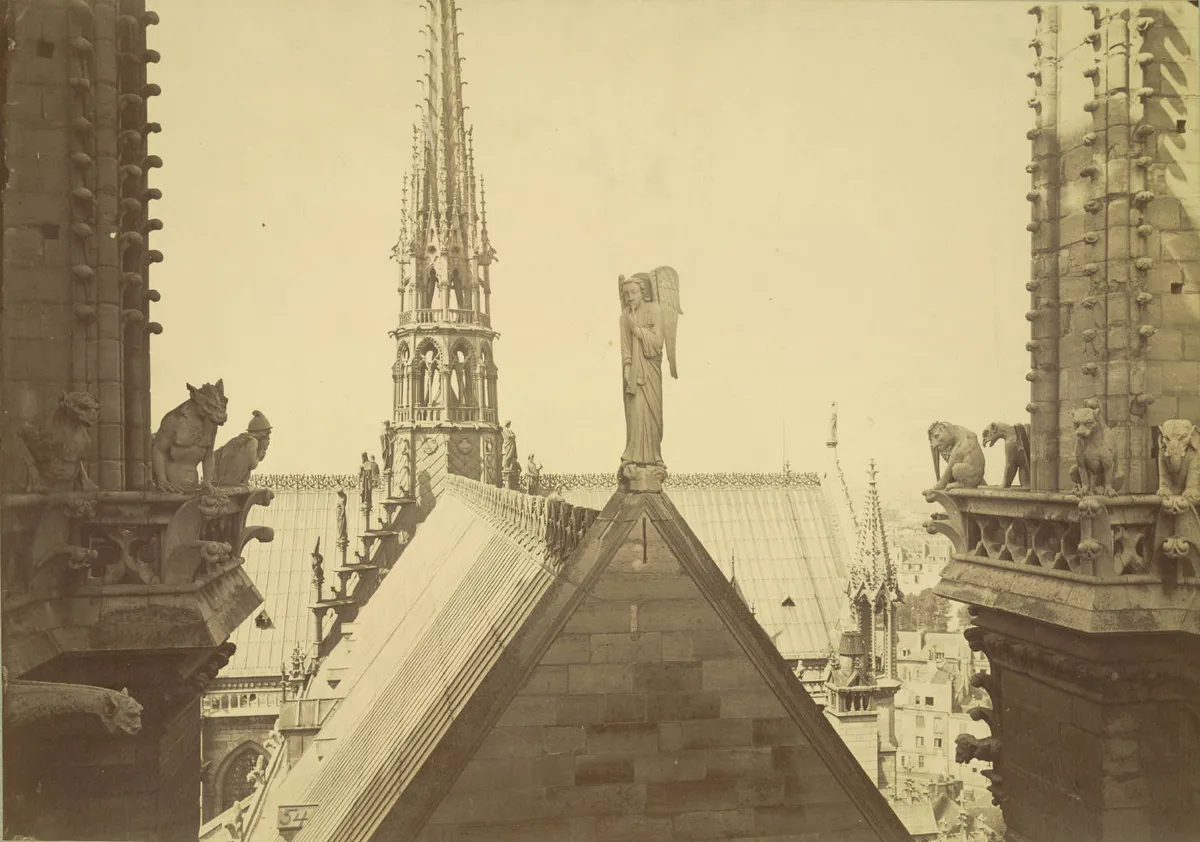
The towers' signature image is the stone monsters gazing pensively over Paris. But you can't really call them medieval: the chimeras were dreamed up by Viollet-le-Duc in the 19th century, during the great restoration. There are more than fifty of them on the gallery between the towers — birds, demons, beasts and creatures that are hard to put a name to.
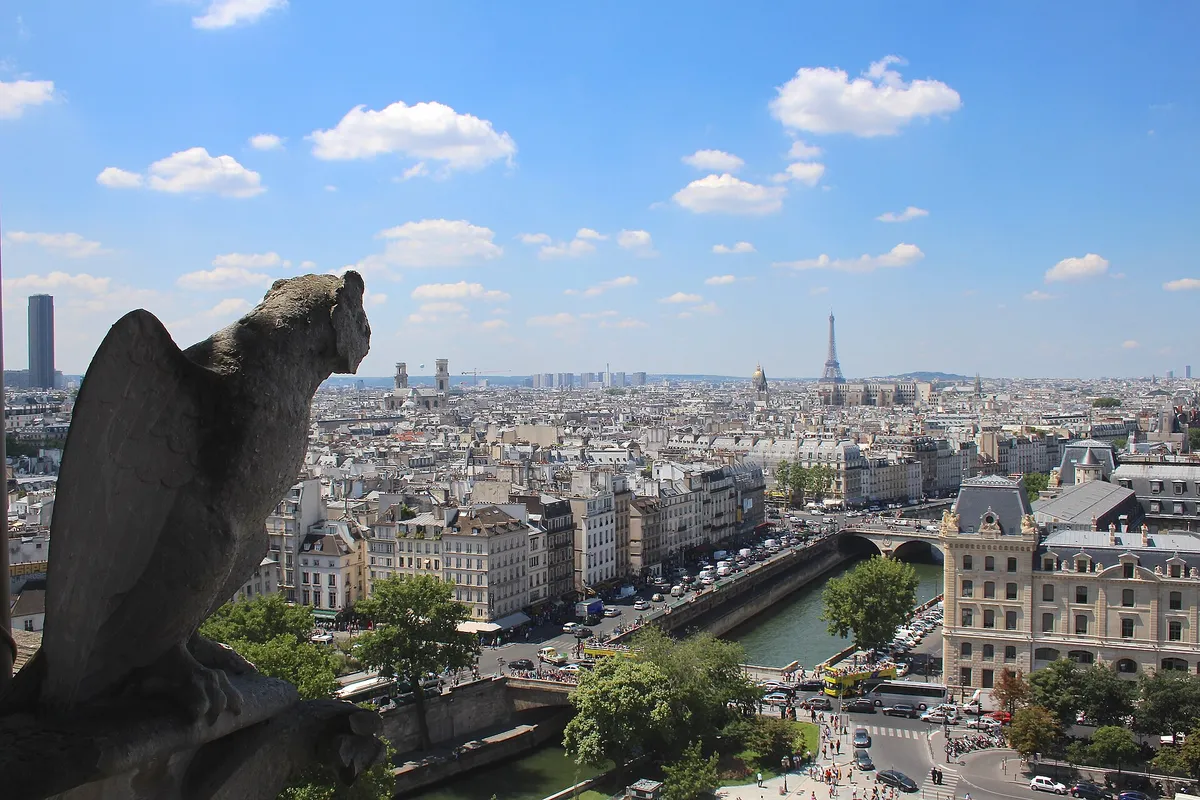
The most famous is the Stryge: a winged creature propping its head in its hands and looking out over the city. Charles Meryon's 1853 etching made it famous, and ever since, the Stryge has been treated almost as a symbol of Notre-Dame. The genuinely medieval monsters here are the gargoyles: they're waterspouts that carry rainwater away from the walls. The chimeras don't carry anything away — they just watch. More on gargoyles, chimeras and the myths around them in our legends article.
In the preface to "Notre-Dame de Paris" (known in English as "The Hunchback of Notre-Dame"), Victor Hugo tells how, while poking around the cathedral one day, he found a Greek word carved into the wall in a dark corner of one of the towers: "ἈΝΆΓΚΗ" — "fate", "necessity". He didn't know who had carved it or why. The novel grew out of that word.
Hugo adds that the inscription later vanished: the wall was either scraped or whitewashed. So there's no point looking for it. But it was here, in the towers, that Hugo housed his bell-ringer, and his 1831 novel got Paris thinking about saving the cathedral.
Notre-Dame's medieval timber roof was nicknamed "the Forest" — that's how many oaks went into its beams. In April 2019 it burned down completely. The decision was made to rebuild it the way it had been built in the Middle Ages: in oak, with beams shaped by hand with axes. The roof frame over the nave was assembled in 2023–2024.
From the cour des Citernes, the courtyard between the towers, the route lets you see this new Forest through openings in the stone. There are few places where you can see so closely how a Gothic cathedral's roof is really put together. What happened on the night of the fire and how the cathedral was restored — in our article on the fire.
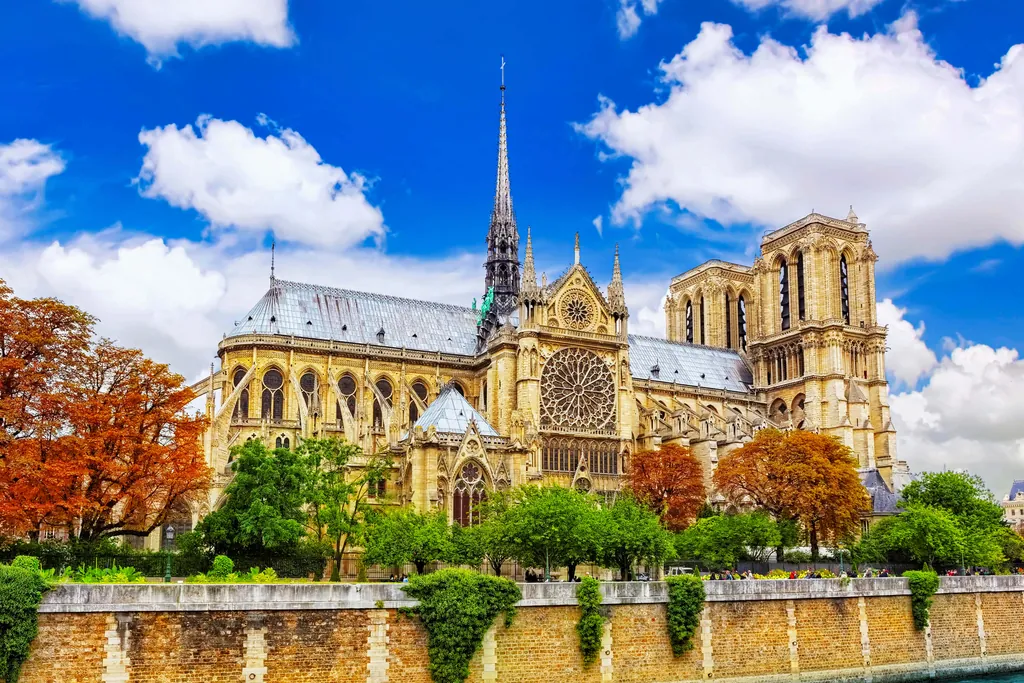
The towers look out over the whole historic centre. Below you are the Seine, the Île de la Cité and the Île Saint-Louis. On the horizon: the Eiffel Tower, the Sacré-Cœur basilica on Montmartre, the dome of the Panthéon and the Tour Montparnasse. Close by are the spire of Sainte-Chapelle and Notre-Dame's own new spire, a replica of Viollet-le-Duc's.
Take a close look at the golden cockerel on top of the spire. It's new: the old one fell during the fire, dented but intact. The new cockerel holds relics and a scroll bearing the names of some two thousand people who worked on restoring the cathedral.
From April to September, last entry is at 10pm. It's a rare chance to see Paris from above at sunset and at dusk, as the lights come on along the quays. For photos, this is the best time: soft light and a city lit up.
Morning slots, right after 9am, are usually quieter, with fewer people at the top. From November to March the towers close at 5:30pm, so in winter it's best to climb in the first half of the day, while it's still light. In rain or strong wind the route may be closed, in which case your ticket is refunded. To find out how to combine the climb with a visit to the cathedral itself without needless waiting, see our guide to the best time to visit.
The climb is genuinely strenuous. The organisers state plainly that it isn't recommended for people with heart failure or vertigo, pregnant women or young children. Passages are 45 centimetres wide in places and low in others — tall visitors will have to duck. There's no lift, so the route isn't accessible to people with reduced mobility; for them, there's a video about the towers with subtitles and sign language.
There are no toilets or drinking water at the top, so bring a bottle and use the toilet before you set off. Children and teenagers under 18 must be accompanied by an adult. No animals except guide dogs. If the climb isn't for you, don't be disappointed: the best of Notre-Dame — the façade, the portals, the rose windows and the interior — is free and doesn't involve a single step.
Small-group and private Notre-Dame tours — a good option if you'd rather ask questions as you go.
How much does it cost to climb Notre-Dame's towers?
From €16 for adults. It's free for under-18s, EU residents aged 18 to 25, disabled visitors and their companion, and Paris Museum Pass holders. But everyone has to book a slot.
Where can I buy tickets for the towers?
Only online, on the official towers website (Centre des monuments nationaux). Tickets aren't sold on site. Third-party sites offering "priority entry" usually just resell the same slot at a higher price.
How many steps are there in Notre-Dame's towers?
424 steps, including the final 123 to the terrace at the top of the south tower. You can skip that last stretch.
How long does the climb take?
About 50 minutes for the whole route, including the way down.
Can you see the chimeras and the bells?
Yes. The route passes the Emmanuel and Marie bells and runs along the galerie des chimères between the towers, and two original chimeras are on display in the first hall.
Does a towers ticket get you into the cathedral?
No, they're separate visits. Entry to the cathedral itself is free. To find out how to get in without a long wait, see our guide to visiting Notre-Dame.
Do the audio guide's outdoor stops on the square while you wait for your slot, then head into the cathedral once you're back down: the indoor stops are waiting for you there.
Get the audio guide — €6.99The GetYourGuide tour link is a partner link: the price is the same for you, and we may earn a small commission. The audio guide is provided by TouringBee.
