The devil's doors, the real Quasimodo, a bell full of jewellery, the Goddess of Reason and the mystery beneath the cathedral floor — what's true, what's invented, and what's still being investigated.
Notre-Dame has two histories. The first is the official one: dates, architects, bishops, kings. The second lived on in the stonemasons' workshops, in the taverns of the Île de la Cité and in the gossip of the bell-ringers — tales of a blacksmith who struck a deal with the devil, of a bell that swallowed jewellery, of a hunchback who may actually have existed.
The fascinating part is that some of these legends turned out to be true, some turned out to be invented, and a few are still being tested today — with laser scanners and forensic scientists. We've gathered twelve stories and taken an honest look at each one: what's fact, what's legend, and whether there's anything you can see with your own eyes.
Many of these stories are quite literally carved into the cathedral's walls. If you want to hunt for them on the spot, the TouringBee audio guide takes you around Notre-Dame and inside it: 31 stops, 13 of them outside, so you can start while you're still in the queue.
| Story | Verdict | What you can see |
|---|---|---|
| The devil forged the doors | Legend | The doors — up close |
| The chimeras are medieval | Myth: they're 19th-century | Gargoyles — from a distance; chimeras — from the towers |
| Quasimodo really existed | Possibly | Story only |
| Hugo locked up his clothes to finish his novel | True | Story only |
| Jewellery was thrown into the bell | Legend | The bell — from the towers, with a ticket |
| Crying "Sanctuary!" saved you from the guards | True, with caveats | The place only — the portals |
| Point Zéro brings you back to Paris | Superstition | The marker — up close |
| The façade is an alchemists' book | 20th-century legend | The medallions — up close |
| The cathedral honoured the Goddess of Reason | True | Story only |
| A poet was found under the floor | Under investigation | Not accessible |
| The bees survived the fire | True | Not accessible |
| A "digital twin" saved the cathedral | True | The result — the whole cathedral |
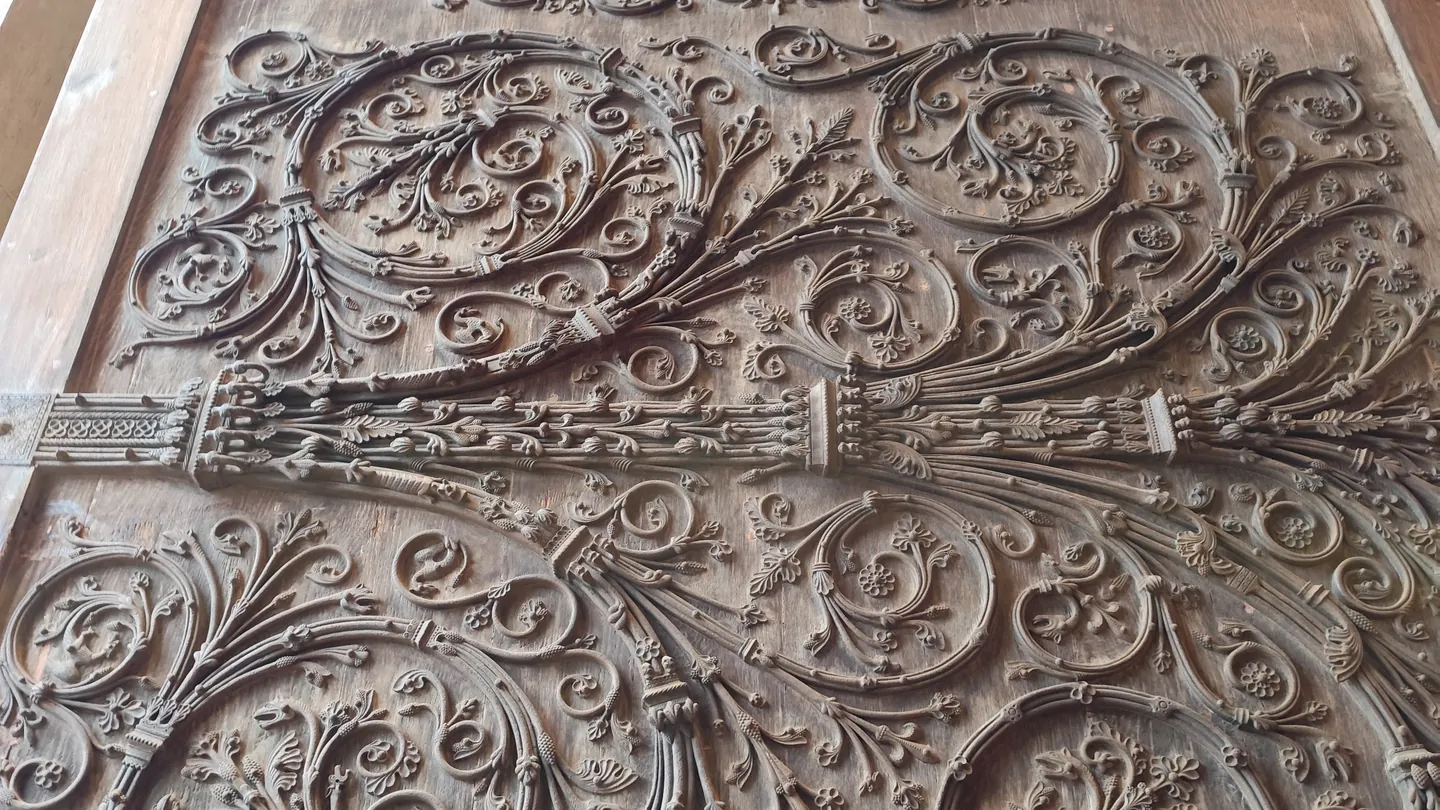
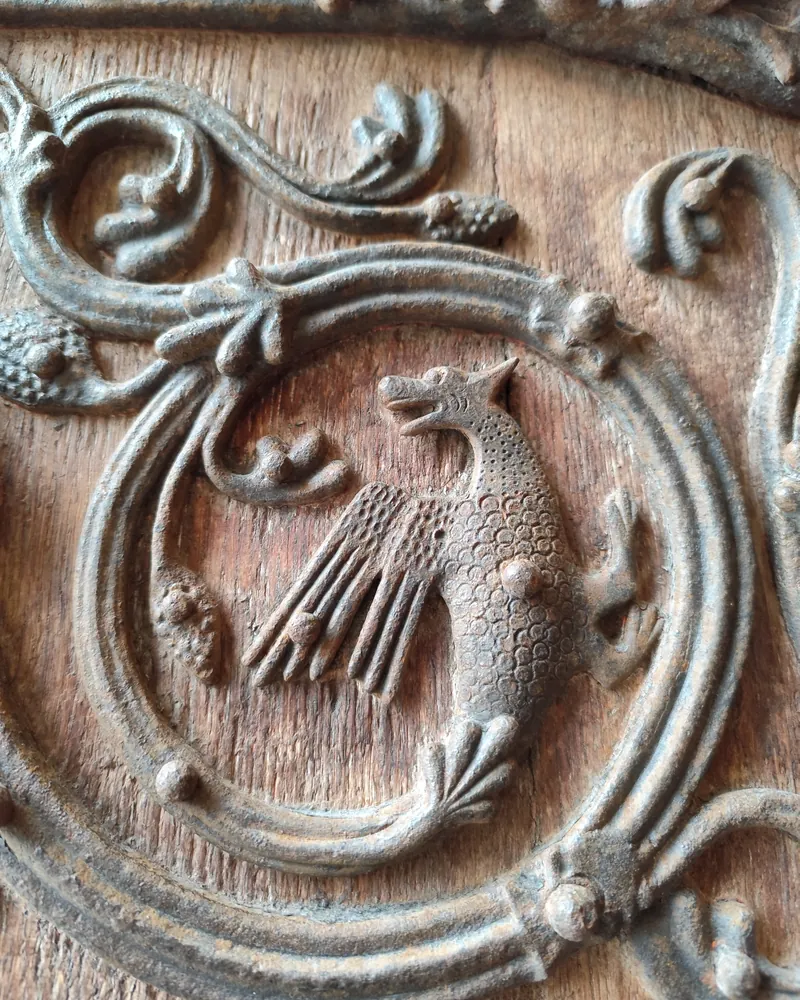
Walk up to the west façade and look at the doors of the side portals. Iron scrolls spread across the wood — tendrils, leaves, birds, tiny animals. The pattern is so delicate and intricate that for centuries people refused to believe human hands had made it.
Hence the legend. The commission for the ironwork went to a young blacksmith named Biscornet. The job was beyond him, the deadline was looming, and one night he made a pact with the devil: help in exchange for his soul. By morning the doors were finished, and Parisians couldn't believe their eyes.
But the deal had a flaw. When people tried to open the doors, the locks wouldn't budge — and gave way only once they had been sprinkled with holy water. And the central portal, through which the Blessed Sacrament was carried in procession, never received any of the devilish ironwork: that door was closed to the powers of darkness. Biscornet himself soon sank into a gloomy silence and died without ever revealing the secret of his work.
The legend is at its most convincing when you're standing in front of those doors, studying the iron up close. That's exactly where the TouringBee audio guide tells it — it's one of the guide's stops at the façade.
Verdict: legend — but the iron is real. Most of the wrought-iron hinges on the side portals have survived from the Middle Ages, and blacksmiths in later centuries seriously debated how anyone had managed to forge them. The ironwork on the central portal was made in the 19th century.
See it for yourself: you can look at it up close — the side portals of the west façade.
Tourists call every stone beast on Notre-Dame a gargoyle. In fact there are two distinct tribes — with very different histories.
Gargoyles are waterspouts. Stone creatures with gaping mouths jut far out from the walls and spit rainwater well clear of the masonry. The word is linked to the Old French gargouille, "throat" — the same root as gargouiller, "to gurgle". In a downpour the cathedral quite literally gurgles in dozens of voices.
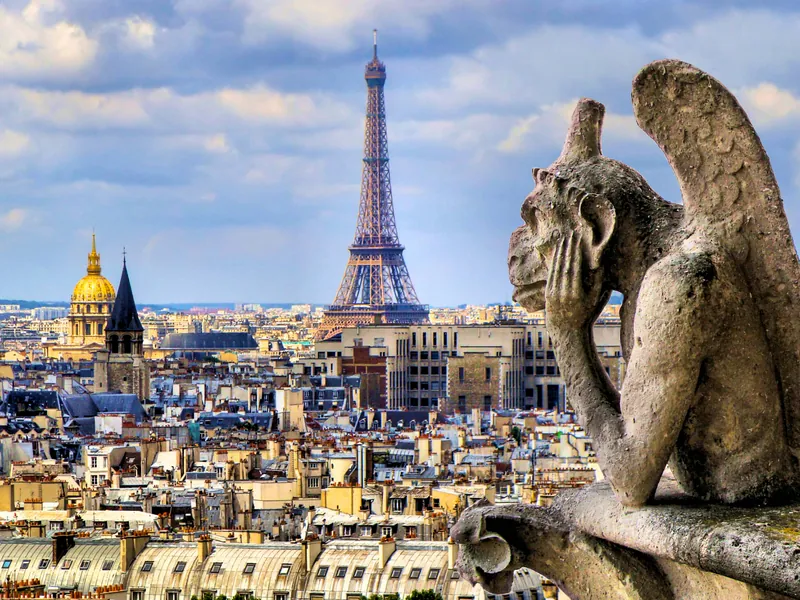
Chimeras don't drain anything. They are the demons, birds and half-human figures perched on the balustrade between the towers, gazing thoughtfully out over the city. And here's the surprise: they aren't medieval at all. They were dreamed up by the architect Eugène Viollet-le-Duc during the great restoration of the mid-19th century — in the spirit of the Romantic Gothic that Victor Hugo had made fashionable. In other words, Notre-Dame's most "ancient" monsters are younger than Quasimodo.
The most famous chimera even has a name — the Stryge. Head propped in its hands, it gazes pensively at Paris. It owes its worldwide fame to the engraver Charles Meryon: in 1853 he made an etching, "Le Stryge", in which the chimera looms over the city's rooftops with birds wheeling around it. Meryon was obsessed with his visions of Paris, and a few years later he was committed to an asylum, where he died. His Stryge, meanwhile, became one of the city's most recognisable images.
Verdict: half true. The gargoyles are medieval in conception (many were recarved during restorations), while the chimeras are a 19th-century invention.
See it for yourself: the gargoyles are visible from a distance — from the square and especially from the south side of the cathedral. The chimeras, including the Stryge, can only be seen up close from the gallery between the towers — with a separate towers ticket.
Download link sent to your email right after purchase · the guide works for 1 year · questions? support@touringbee.com
Get the Audio Guide — €6.99Notre-Dame audio guide: route, stops & what's inside →The hunchbacked bell-ringer was Hugo's invention. That's what everyone believed for a century and a half — until 2010, when the Tate Archive in London made a curious discovery public.
It was the handwritten memoir of the British sculptor Henry Sibson. In the early 1820s the young Sibson worked in Paris on government commissions, including repairs to Notre-Dame, where he carved the stone foliage around the windows. In his recollections he mentions a man the workshop called "Le Bossu" — "the Hunchback".
Hugo lived nearby in those same years and took a keen interest in the cathedral's restoration. One more detail made researchers sit up: Sibson mentions a carver named Trajan, and in an early draft of "Les Misérables" the hero was called Jean Tréjean — he later became Jean Valjean.
Verdict: possibly. There's no direct proof that Hugo knew this hunchback — only coincidences. But very beautiful ones.
See it for yourself: story only — no physical trace remains.
Hugo had to deliver "Notre-Dame de Paris" to his publisher by a set deadline — and he was hopelessly behind. So he took drastic measures: according to his wife, Adèle, he bought himself a shapeless knitted shawl and locked all his respectable clothes away, so he wouldn't be tempted to go out into town. With nothing to go out in, all he could do was write. The novel was finished in a matter of months and published in 1831.
Three more details surprise a lot of people. First, there's no "hunchback" in Hugo's title: the novel is simply called "Notre-Dame de Paris" — "The Hunchback of Notre-Dame" was the invention of its English translators. Second, before Hugo, "Gothic" was almost an insult: ever since the Italian Renaissance the word had been used for "barbarous" art supposedly created by the Goths. The novel turned that attitude on its head — and soon afterwards the great restoration of the cathedral began.
Third, in his preface Hugo writes that while wandering through the cathedral he once found, in a dark corner of one of the towers, the Greek word ΑΝΑΓΚΗ — "Fate" — carved into the wall. When he came back, the inscription had been scraped away. According to Hugo, it was those letters that prompted him to write the novel. Nobody knows whether the inscription really existed: many historians consider it an elegant literary device.
Verdict: true (the clothes story comes from Hugo's wife; the inscription from Hugo himself).
See it for yourself: story only.
In the south tower hangs Emmanuel, Notre-Dame's great bell — its "bourdon". It was cast in 1686, with Louis XIV and Queen Maria Theresa as its godparents. It weighs around 13 tonnes and sounds an F sharp — so deep that you feel it in your chest more than hear it with your ears.
Legend has it that while the molten metal was seething in the mould, noblewomen of Paris threw gold and silver jewellery into it — and that's why Emmanuel's voice is so velvety. There's no way to check that today, and bell founders are sceptical: jewellery in those quantities has almost no effect on the sound.
The bell's real biography is every bit as good as the legend, though. During the Revolution the cathedral's bells were sent to be melted down — Emmanuel survived. In August 1944 it announced to Paris that the troops liberating the city from the Nazis had arrived; on 12 September 2001 it tolled for almost an hour in memory of the victims of the attacks in New York; and in 2019 it survived the fire.
Verdict: legend — but the voice is real.
See it for yourself: you can't see the bell from the square, but you can hear it on major feast days. Up close — only on the towers climb, with a separate ticket: the new route passes right by Emmanuel.
The most dramatic scene in Hugo's novel: Quasimodo snatches Esmeralda from the foot of the gallows, races into the cathedral with her in his arms and cries "Sanctuary!" The guards freeze on the threshold.
This isn't artistic licence. In the Middle Ages churches held the right of sanctuary: a fugitive who took refuge in a church was, for a time, beyond the reach of secular justice. Violating that right meant defying the Church — and few dared. Over time the kings whittled the privilege down, and by the 16th century it had all but disappeared, so the novel's setting (1482) falls in its final decades.
Verdict: true — with caveats. Historians still argue over exactly where the boundary of sanctuary lay: only inside the cathedral, or across the whole cloister precinct around it.
See it for yourself: the place only — the portals of the west façade, where fugitives sought safety. No physical trace remains.
A few dozen metres from the main entrance, set into the paving of the square, is a round marker with a bronze star and the inscription Point zéro des routes de France. It was installed in 1924: distances from Paris to other French cities are measured from this point.
Every Paris tour guide knows the superstition: stand on the star and you're sure to come back to Paris. Some people make a wish, some people kiss. That's why there's almost always a little queue of people waiting for a photo.
The irony is that the spot has a grim past. Long before the star, condemned prisoners knelt here in front of the cathedral to publicly confess their crimes, and a pillory stood nearby.
Verdict: superstition — but the point is entirely real.
See it for yourself: you can look at it up close and stand on it — for free.
At the bottom of the central portal, on either side of the entrance, run rows of small stone medallions. Most people walk straight past without noticing them. Yet in the 20th century they drew genuine pilgrims — alchemists and occultists.
It all began with a book, "Le Mystère des Cathédrales" ("The Mystery of the Cathedrals"), published in 1926 under the pseudonym Fulcanelli. Its author claimed that Notre-Dame's façade was a coded alchemy textbook, and that the sequence of reliefs concealed the recipe for the philosopher's stone. Who was behind the pseudonym has never been established — which only fuelled the intrigue.
Verdict: a 20th-century legend. For the medieval craftsmen, the medallions were a "Bible for the illiterate" — visual depictions of the virtues and vices. But studying them with Fulcanelli's theory in mind is remarkably entertaining.
See it for yourself: you can look at them up close — the lower tier of the central portal.
On 10 November 1793 Notre-Dame lived through what was perhaps the strangest day in its history. The revolutionaries declared the cathedral a Temple of Reason and staged a festival there for a new, "rational" faith. An artificial mountain was built in the nave, a Temple of Philosophy was placed on its summit, and the role of the Goddess of Reason was played by an actress from the Paris Opéra — in a white dress, a blue cloak and a red Phrygian cap.
The celebration was short-lived. The cathedral was soon turned into a warehouse — provisions and wine barrels were stored here, while the statues on the façade were being smashed.
Verdict: true. This is a documented event, not an anecdote.
See it for yourself: story only — nothing remains of the "mountain" or the Temple of Philosophy.
Small-group and private Notre-Dame tours — a good option if you'd rather ask questions in real time.
After the 2019 fire, before the scaffolding went up to rebuild the spire, archaeologists were given an extraordinarily rare opportunity: to open up the cathedral floor at the crossing. In 2022 they found two lead sarcophagi there.
The first was quickly identified from its inscription: it held the canon Antoine de La Porte, who died in the early 18th century. The second was anonymous. Scientists from Toulouse studied the remains and found that this man had ridden a great deal, suffered from a chronic illness and died young — which is why the press nicknamed him "the Horseman". Their hypothesis: he is the Renaissance poet Joachim du Bellay, who died in 1560 at the age of 37. His family had asked for him to be buried in Notre-Dame, but his grave was lost as early as the 18th century.
Something else turned up under the floor too: painted fragments of the medieval choir screen (the "jubé"), dismantled in the early 18th century. Their vivid blues and reds are remarkably well preserved — further proof that Gothic was never grey.
Verdict: the investigation continues. Some specialists find the du Bellay theory convincing; others say doubts remain.
See it for yourself: not accessible — the finds are being studied by scientists, and the excavation site has been covered by the floor again. But as you pass through the crossing, you'll be standing practically on top of it.
Few people know that Notre-Dame has bees of its own. Since 2013, three hives have stood on the roof of the sacristy, on the south side of the cathedral — home to around 180,000 bees.
On the night of the fire, 15 April 2019, they were presumed dead. But the hives sat some 30 metres below the burning roof, and the flames never reached them: beeswax melts at 63 °C, and it never got that hot down there. A few days later the cathedral's beekeeper, Nicolas Géant, announced that the bees were alive and already flying.
Verdict: true.
See it for yourself: not accessible — the hives are on a roof that's closed to visitors.
In 2010 the American architectural historian Andrew Tallon of Vassar College came to Notre-Dame with a laser scanner. He moved the instrument around some fifty times — inside and out — and gathered more than a billion points: the most accurate 3D model of the cathedral at the time, down to every column and every stone.
The scans demolished the romantic myth of Gothic's "flawless geometry". Tallon went looking for places where "something's not quite straight or not quite plumb" — and found them everywhere: walls and columns stray noticeably from perfect lines. He described the western part of the cathedral to National Geographic in far less reverent terms. The builders spent almost a hundred years adapting to the island's ground and to changing plans — and it shows in the stone.
In November 2018 Tallon died of cancer at 49. Five months later, on 15 April 2019, Notre-Dame caught fire. His data became one of the mainstays of the restoration: according to Philippe Villeneuve, chief architect of the restoration, the scan made it possible to rebuild the vaults with confidence in their dimensions and shape.
Verdict: true.
See it for yourself: there's no physical trace — but the whole restored cathedral is, in a sense, the result of his work.
Is it true the devil forged Notre-Dame's doors?
That's the legend of the blacksmith Biscornet. The wrought-iron hinges on the side portals are largely medieval, and their complexity amazed craftsmen for centuries — hence the tales of dark forces.
What's the difference between gargoyles and chimeras?
Gargoyles are waterspouts that carry rainwater away from the walls. Chimeras are decorative figures on the gallery between the towers, added by Viollet-le-Duc in the 19th century.
Did a real Quasimodo exist?
Nobody knows for sure. The memoir of the sculptor Henry Sibson, found in the Tate Archive, mentions a man nicknamed "the Hunchback" who worked in the 1820s in Paris workshops connected with repairs to the cathedral, but a link to Hugo has never been proven.
Where is Paris's Point Zéro?
On the square in front of Notre-Dame, a few dozen metres from the main entrance: look for a round marker with a bronze star set into the paving. Standing on it is free.
Can you see the chimeras and the Emmanuel bell?
Yes, on the climb up the cathedral's towers — you need a separate paid ticket, and it's best to book ahead. More in our tickets guide.
Start the audio guide on the square while you wait to get in — and finish it inside.
Get the audio guide — €6.99The GetYourGuide tour link is a partner link: the price is the same for you, and we may earn a small commission. The audio guide is provided by TouringBee.
