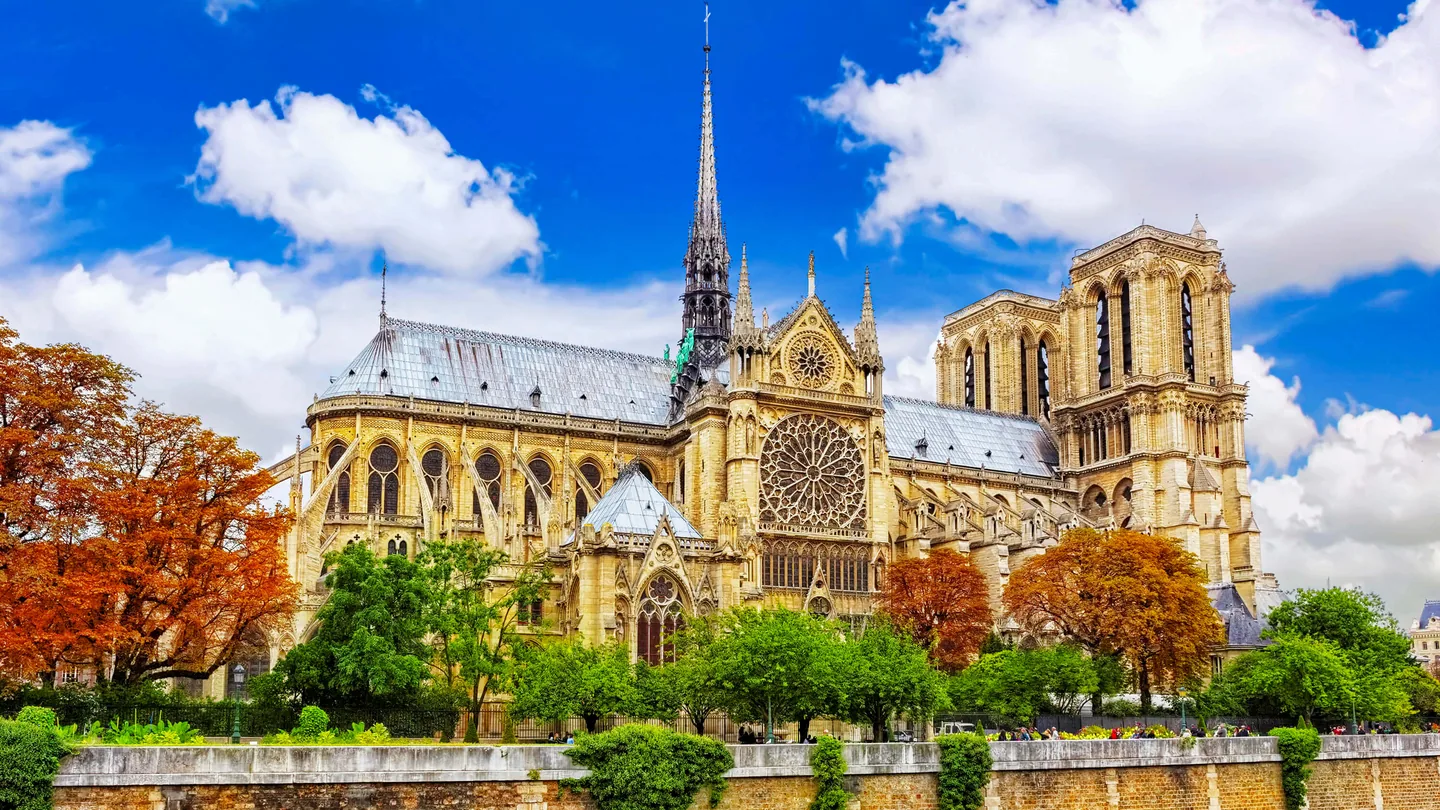
Reopened and brighter than ever. Everything you need for a great visit: entry and reservations, tickets, the best time to go, what to see inside and out, the fire and the rebuild — and the stories that make it unforgettable.
For five years, the most famous cathedral in the world was a building site behind a fence. On December 8, 2024, Notre-Dame de Paris reopened — cleaned, rebuilt, and, to almost everyone's surprise, brighter than it had been in living memory. If you're planning a visit now, this is the one guide that pulls the whole thing together: how to get in, when to go, what's free and what isn't, what to look for inside and out, and the stories that turn a twenty-minute walk-through into the visit you'll actually remember.
We've written detailed guides to each piece of this — tickets, timing, the fire, the island it stands on — and we'll point you to them as we go. Think of this page as the map, and the TouringBee audio guide as the voice in your ear once you're standing in front of it.
This is the first thing people want to know, and the answer is a clear yes. The cathedral reopened in December 2024, five years and nearly eight months after the fire that destroyed its roof and spire. What visitors notice first isn't the new timberwork hidden above the vault — it's the light. Centuries of soot and candle grime were cleaned from the pale limestone during the restoration, and the interior came back markedly brighter than anyone alive had seen it. The spire is new but identical to the one that fell; the stone is cleaner; the organ, nearly 8,000 pipes, has been rebuilt and plays again. Work continues on parts of the exterior and the forecourt into roughly 2027, but the cathedral itself is fully open. The whole dramatic arc — the night it nearly collapsed, the hour that saved it, and the five-year rebuild — is worth knowing before you go: we tell it in full in the Notre-Dame fire guide.
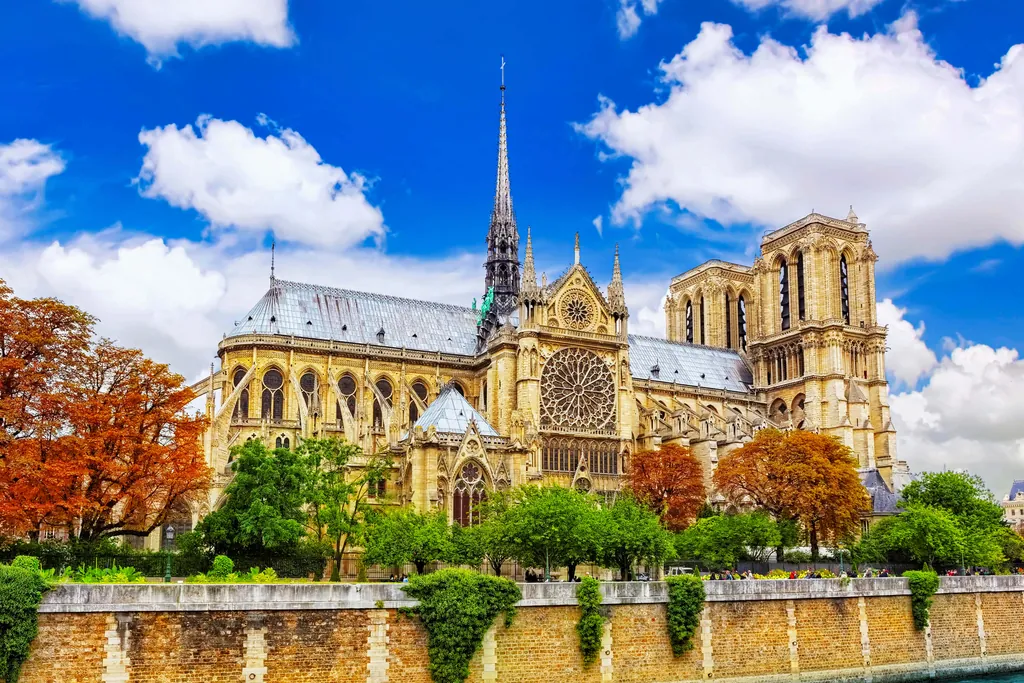
Entry to Notre-Dame is free — it always has been; it's a working cathedral, not a museum. What's new since the reopening is the demand. A free timed reservation, booked online in advance, is strongly recommended and will save you the longest wait; a separate, shorter line exists for people coming to pray. Bags are checked at a security point, large backpacks aren't allowed and there's no cloakroom, and a dress code is enforced at the door — shoulders and knees covered. None of it is complicated once you know it, but it catches a lot of visitors off guard. Our step-by-step guide to visiting Notre-Dame covers reservations, security, the dress code and the etiquette inside a cathedral that's holding Mass while you walk through it.
If you can, go early. The first hour after opening and the last hour before closing are the calmest; the middle of the day, weekends, and the summer peak are the busiest. Season matters too — a weekday in November is a completely different experience from a Saturday in July. Light matters as well: the south rose window is at its best when the afternoon sun is behind it. We break down the quietest hours, days and months, and the best light for photos, in the best time to visit guide.
Here's the part that confuses people. The cathedral itself is free. What costs money are the extras: climbing the towers (the famous view, up among the gargoyles — reserved separately and in high demand), the archaeological crypt under the square, and the Treasury with its relics and reliquaries. Guided tours and, of course, the audio guide are separate again. If you want to know exactly what each one costs, what's worth it, and what you can skip, our tickets guide lays it all out.
Most people walk straight up to the doors and miss the best lesson Notre-Dame offers — the one carved across its front. The west facade is a book in stone: the gallery of twenty-eight kings across the middle, the three great portals carved like a medieval comic strip, the central rose window, and the two towers framing it all. For a city that was largely illiterate when this was built, the sculpture was the text — the "poor man's bible." Learn to read it and the facade stops being decoration and becomes a set of stories. And then there are the famous grotesques high on the towers — which raises a question most visitors get wrong: the difference between a gargoyle and a chimera. (One is plumbing; the other is pure 19th-century imagination. The audio guide tells you which is which, and where to look.)
Download link sent to your email right after purchase · the guide works for 1 year · questions? support@touringbee.com
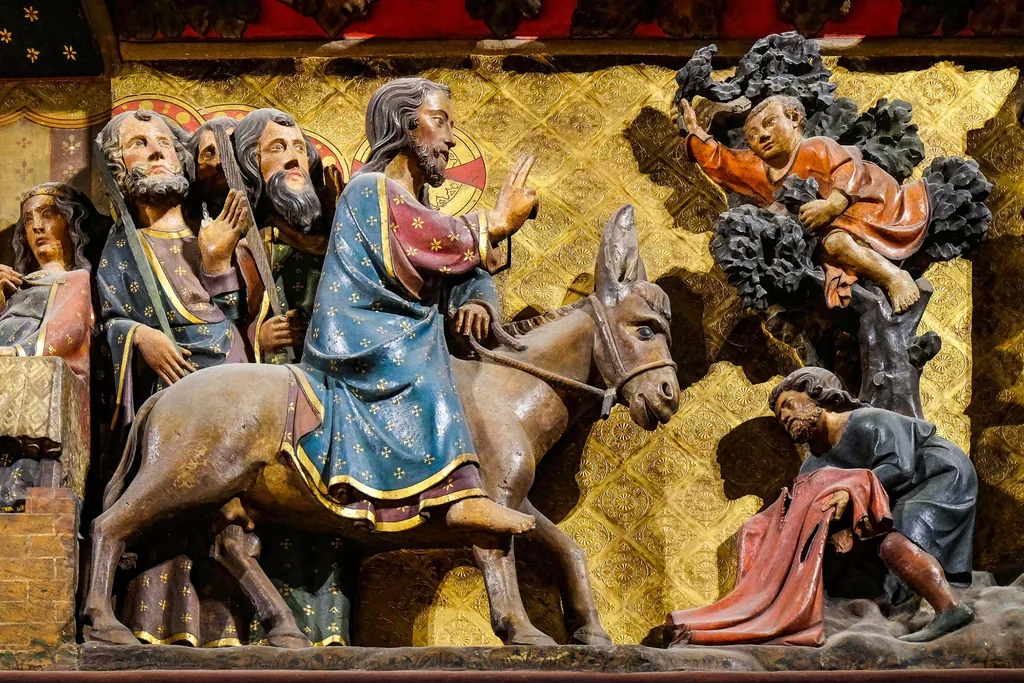
Get the Audio Guide — €6.99Notre-Dame audio guide: route, stops & what's inside →Inside, three things stop almost everyone. The three rose windows — the oldest glass dating to the 13th century, and all three survived the fire — glow like walls of jewels when the light is right. The great organ, one of the largest in France, survived the flames and was painstakingly cleaned of lead dust, pipe by pipe. And the cathedral's relics, including the Crown of Thorns, carried out of the burning building by a human chain in 2019, are kept in the Treasury. Beyond the headline sights there are chapels, tombs, a 14th-century choir screen carved with the life of Christ, and the famous statue of the Virgin of Paris. Knowing what you're looking at — and why it matters — is the whole difference between walking past and actually seeing it.
You can't understand today's Notre-Dame without the night of April 15, 2019. The roof and spire burned and collapsed, but the stone vault beneath held like a shield, the towers were saved by firefighters who went up into the flames, and a chain of people carried the relics to safety. Then came a five-year rebuild, €840 million in donations from 340,000 people across 150 countries, 2,000 oak trees for a new medieval-style frame, and a national argument over whether to rebuild it exactly as it was or add a modern touch. (They chose "à l'identique" — identical — with one small modern concession.) It's one of the great stories of our time, and we tell all of it — what was lost, what survived by luck, and how it came back — in the fire guide.
This is where a visit tips from "nice" to unforgettable. Standing on the square, you're on ground that has staged two thousand years of Paris — and the cathedral has seen things that sound invented:
We don't spoil the endings here — they're best heard on the spot, in front of the exact stone they belong to. That's precisely what the TouringBee audio guide is for: 31 stops, written by a professional historian, that start on the square and carry on through the interior, in 10 languages and fully offline.
Construction began in 1163 under Bishop Maurice de Sully, on the site of earlier churches, and the main structure took the better part of two centuries. It was a radical building for its day — one of the first to use flying buttresses, which let the walls rise higher and open up for huge windows. It crowned a French king's story more than once, was ransacked and rededicated to "Reason" during the Revolution, and then fell into such neglect that demolition was seriously discussed. What saved it was a novel: Victor Hugo's The Hunchback of Notre-Dame (1831) made the public fall back in love with the cathedral, and a major 19th-century restoration by Eugène Viollet-le-Duc followed — he designed the spire that would later burn. Napoleon crowned himself Emperor here in 1804. The 2019 fire and the 2024 reopening are simply the latest chapters in a very long story. The audio guide threads all of this through the things you can actually see as you walk.
Compare small-group and private Notre-Dame and Île de la Cité tours — a good option if you'd rather have a person walking you round with questions answered in real time.
Notre-Dame doesn't stand alone — it sits at one end of the Île de la Cité, the island in the Seine where Paris itself began as a Roman town called Lutetia. Steps away are the dazzling stained glass of Sainte-Chapelle, the former royal palace and prison of the Conciergerie, the flower market, and the quiet tip of the island where locals picnic. If you've come all this way, the cathedral is really the centrepiece of a half-day on the island — we map the whole walk, story by story, in the Île de la Cité walking guide.
Stay a short walk from the Île de la Cité and you can be first through the doors in the morning, before the crowd — and make a half-day of the island.
Is Notre-Dame open to visitors in 2026?
Yes. The cathedral reopened on December 8, 2024, and is fully open. Entry is free; a free timed reservation is recommended. Work on parts of the exterior and surroundings continues into about 2027.
How much does it cost to visit?
Entering the cathedral is free. The towers, the archaeological crypt and the Treasury have separate tickets, and guided tours and the audio guide are extra. See our tickets guide for current prices.
How long should I spend there?
Plan on about two hours to do it justice, inside and out. A quick look is 20–30 minutes; with an audio guide, around two hours.
Can you climb the towers?
The towers reopened in stages after the restoration and are visited on a separate, timed ticket that sells out quickly. Details and booking advice are in the tickets guide.
What's the best time to avoid the crowds?
Early morning or late afternoon, midweek, outside the summer peak. Our best time to visit guide has the details by hour, day and season.
Do I need a guide or an audio guide?
You can walk through for free, but almost nothing is labelled with its story. A self-guided audio tour is the easy way to understand what you're seeing — the TouringBee guide has 31 stops in 10 languages, works offline, and is €6.99 on this site.
The audio guide normally sells for €9.99. On this site it's automatically €6.99 — an exclusive discount for our readers, applied at checkout with nothing to enter.
€9.99 €6.99 — the Notre-Dame audio guide, 31 stops in 10 languages, fully offline. Applied automatically at checkout: no code needed. See what's inside the audio guide →
Notre-Dame is extraordinary even on a quick walk-through — but it rewards knowing what you're looking at. Plan with our guides above, go early, and let the stories play in your ear as you stand in front of each one: 31 stops, ~2 hours, 10 languages, fully offline. Readers of this site get the audio guide for €6.99 instead of €9.99 — applied automatically at checkout.
Get the audio guide — €6.99Some links on this page are partner links (Booking.com, Tiqets, GetYourGuide). The price is the same for you; we may earn a small commission. The audio guide is provided by TouringBee.
