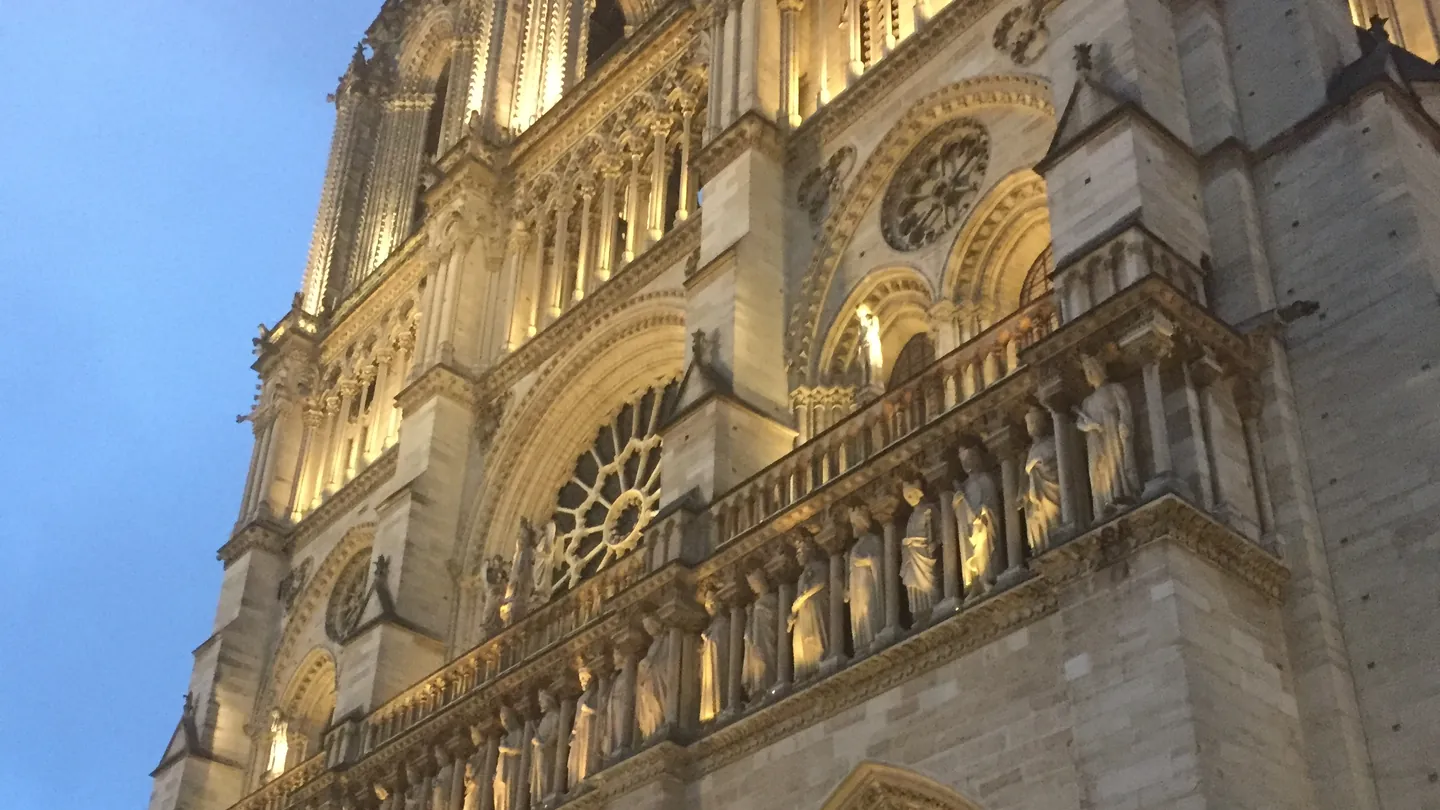
A free cathedral for the whole city and a paid chapel built for a single relic: we compare prices, booking, security, light and time — and suggest a plan for seeing both.
From the doors of Notre-Dame to the Sainte-Chapelle is about 500 metres — a seven- or eight-minute walk across the Île de la Cité. Both are Gothic masterpieces, both were rising at almost the same time in the 13th century, and both appear on almost every list of things to see in Paris. Yet they could hardly feel more different: a vast cathedral that is open to everyone and free, and a small royal chapel where the walls are made of glass and entry requires a paid, timed ticket.
The short answer: if you have the time, do both — they fit neatly into a single day. If you don't, below is an honest comparison to help you choose based on the weather, your budget and your time.
| Notre-Dame | Sainte-Chapelle | |
|---|---|---|
| Entry | Free | €16 for EEA nationals and residents, €22 for everyone else |
| Booking | A free time slot is recommended but not required | A timed slot is mandatory — even if you already have a ticket |
| Security | At the cathedral entrance | Enhanced: the chapel stands within the Palais de Justice |
| Time needed | 60–90 minutes inside | 45–60 minutes, plus the security queue |
| Weather | Barely affected by the light | Beautiful in any light, but the windows are at their most vivid in sunshine |
| The main draw | Scale, history, sculpture, rose windows | Walls of glass: 15 windows and 1,113 scenes |
Prices are taken from the official Sainte-Chapelle website as of October 2026.
Compare Sainte-Chapelle tickets and combined tickets with the Conciergerie. A timed slot is mandatory — book ahead, especially for a sunny morning.
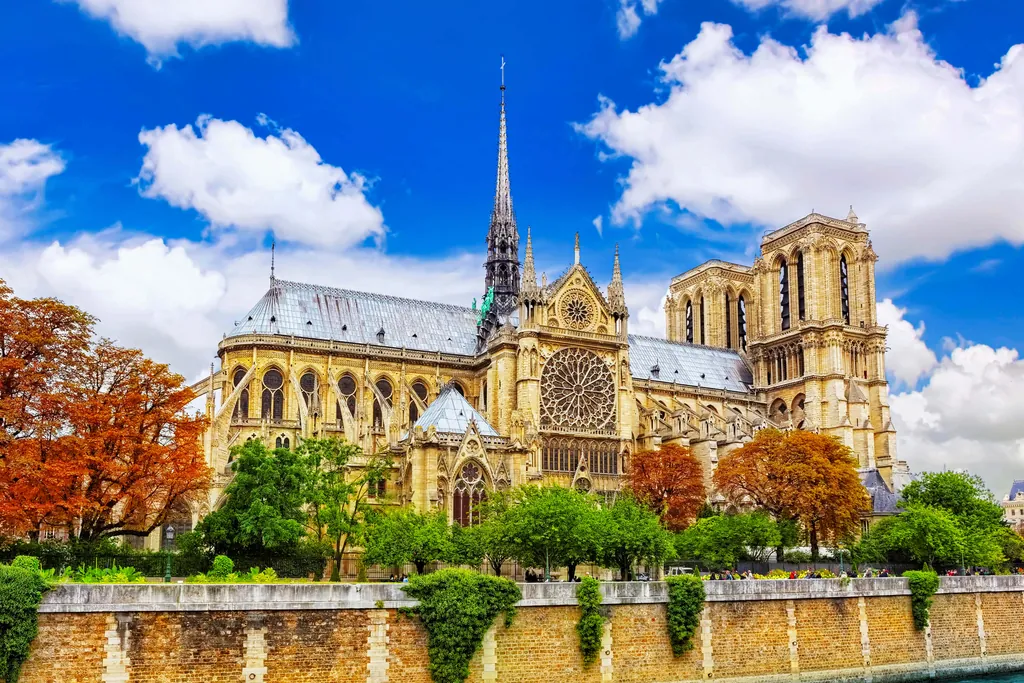
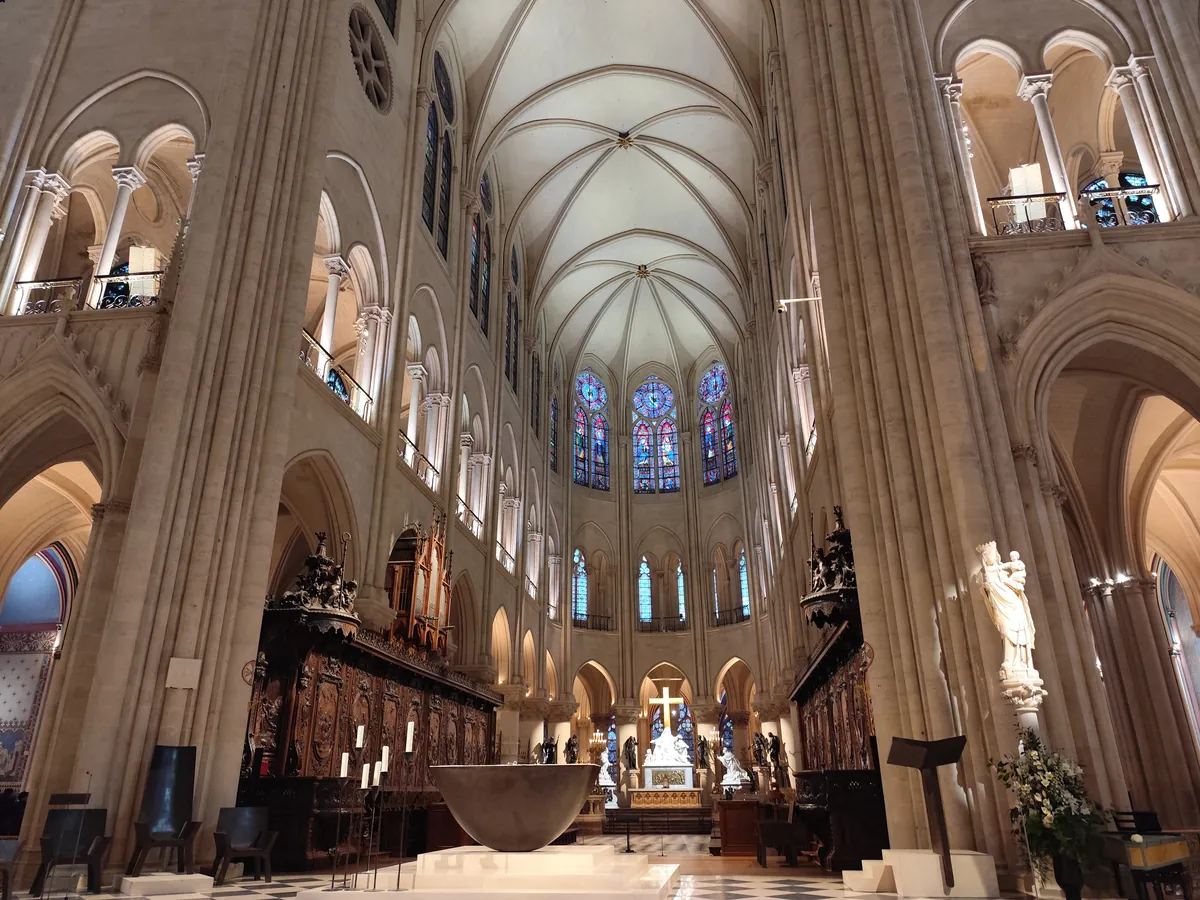
Notre-Dame is a cathedral: the bishop's seat and the city's principal church, open to all. Work began in 1163; the main construction took about a hundred years, and individual parts were still being completed and rebuilt until the middle of the 14th century. Over that time, generations of master builders and several architectural ideas came and went.
The Sainte-Chapelle is a different story entirely. It was the chapel of the royal palace, built by Louis IX as a giant stone reliquary for the Crown of Thorns and other relics of Christ's Passion. It went up astonishingly fast: work began in the early 1240s, and it was consecrated on 26 April 1248. The upper chapel was reserved for the king and his court; the lower chapel was for the people who served in the palace.
Hence the difference in how they feel. At Notre-Dame you are part of the crowd, like a medieval Parisian. At the Sainte-Chapelle you are a guest in the king's private treasure chest.
Louis IX paid 135,000 livres for the Crown of Thorns. Building and glazing the Sainte-Chapelle cost around 40,000 — so the chapel itself cost roughly a third of the relic it was built to house. The king spent about another 100,000 livres on a silver shrine for the relics.
The shrine did not survive: it was melted down for its metal during the Revolution. The Crown itself came through everything and, in the early 19th century, moved to Notre-Dame. So the island's two great sights are linked by a single object: the Sainte-Chapelle was built for the Crown, but today it is kept at Notre-Dame.
You can't see the relic itself at just any time. According to the cathedral, the Crown is displayed for veneration on Fridays — usually from 15:00 to 18:30 — and on the first Friday of the month there is a veneration in the nave from 15:00 to 17:00; during Lent and Holy Week the schedule is different. Check the current schedule on the cathedral's website before your visit. More in our guide to what to see inside Notre-Dame.
Climb the narrow spiral staircase from the lower chapel and the walls seem to vanish. Fifteen stained-glass windows, each about 15 metres tall, fill almost the entire surface — around 670 square metres of glass in all. They contain 1,113 scenes, from the Creation to the story of the relics themselves and their arrival in Paris. Each window has its own sequence of scenes, so don't try to "read" everything in order — pick one or two windows and study them closely. Roughly two-thirds of the glass is original 13th-century work.
A tip few visitors know: bring binoculars or use your phone's zoom. Many of the scenes are high up, and according to the Centre des monuments nationaux, about a third of them are impossible to make out with the naked eye.
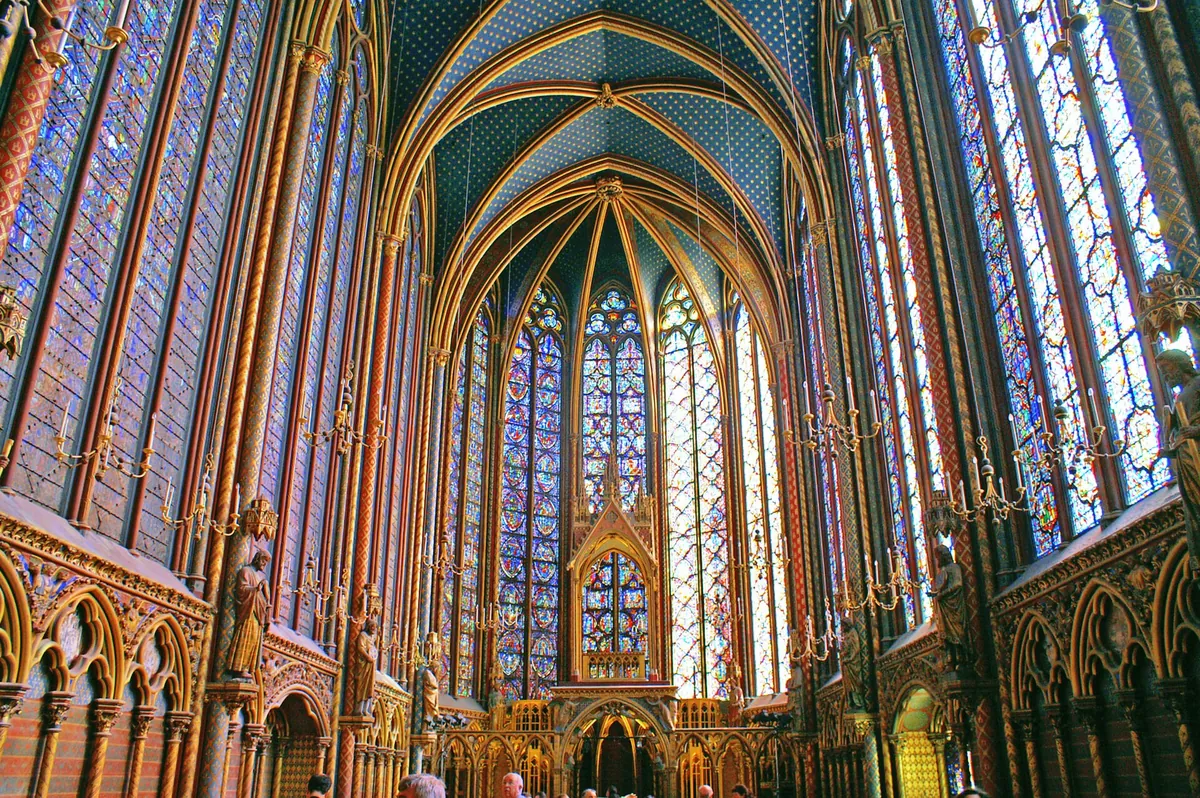
Notre-Dame's glass is magnificent too — especially the two transept roses, each about 13 metres across — but there it is just one part of an immense space. At the Sainte-Chapelle, the glass is the space.
The Sainte-Chapelle suffered no less than Notre-Dame. During the Revolution its spire was torn down, the royal emblems were smashed and the relics were scattered. Later the chapel became a store for the archives of the Palais de Justice: according to the Centre des monuments nationaux, it was handed over to the court archives in 1803, and the lower sections of the windows were removed.
In May 1871, in the last days of the Paris Commune, fire destroyed most of the Palais de Justice, on whose grounds the chapel stands. The Sainte-Chapelle survived. Today's 33-metre spire is 19th-century work, put up in the 1850s during the restoration led by the architect Lassus — the same Lassus who restored Notre-Dame alongside Viollet-le-Duc.
On a sunny day the Sainte-Chapelle's windows blaze blue and red; on an overcast one they look different — calmer and more muted. The chapel is worth visiting in any weather, and diffused light can even help you make out individual scenes without harsh contrasts. But if the forecast promises sun for only part of the day, try to schedule the Sainte-Chapelle for those hours.
Notre-Dame depends less on the light: its strengths are scale, portal sculpture and history, so it's easier to fit into your day at any time. Sunshine does bring its rose windows to life, of course.
Notre-Dame. Entry is free. You can book a free timed slot in advance, but you don't have to: a booking cuts your wait, and without one you join the general queue. The towers, the treasury and the archaeological crypt are paid separately; for what's currently open and how to book, see our tickets guide.
Sainte-Chapelle. According to the official website, an individual ticket costs €16 for nationals of European Economic Area countries and for people who have been resident there for more than 4 months, and €22 for all other visitors. A combined ticket with the Conciergerie costs €23 and €30 respectively. Entry is free for under-18s, and for 18–25-year-olds who are EU nationals or non-European regular residents of France. It is also free on the first Sunday of January, February, March, November and December. You need to book a visit time on the ticketing website even if you already have a ticket, and arrive for your slot, not earlier.
Security. The chapel stands within the Palais de Justice, so ID checks and enhanced security screening are possible, and a booking doesn't exempt you from them. Prohibited items include glass bottles, knives and scissors, aerosols, large bags and suitcases; confiscated items are not returned. Opening hours: April to September, 9:00–19:00; October to March, 9:00–17:00; last entry 30 minutes before closing; closed on 1 January, 1 May and 25 December.
Prices and rules change, so check them on the official Sainte-Chapelle website before you go.
It's easiest to start with the Sainte-Chapelle on the first slot, at 9:00, and to book your Notre-Dame slot with time to spare. This is an approximate plan: security and queue times are not guaranteed.
| Quick version | Relaxed version | |
|---|---|---|
| Sainte-Chapelle | 9:00–10:00 | 9:00–10:30 |
| Walk and buffer | 10:00–10:30 | 10:30–11:00 |
| Notre-Dame | 10:30–12:00 | 11:00–12:30 or until 13:00 |
Start getting to know Notre-Dame before you even go in: the TouringBee audio guide has 13 stops outside the cathedral and 18 inside. You can explore the façades before your visit, then continue the route through the interior.
There's another option too: the Sainte-Chapelle in the morning and Notre-Dame in the evening — on Thursdays the cathedral is open until 22:00. If you have time to spare, the Conciergerie is next door — the former prison where Marie-Antoinette was held before her execution — and our Île de la Cité walking guide covers it along with the rest of the island.
Download link sent to your email right after purchase · the guide works for 1 year · questions? support@touringbee.com
Get the Audio Guide — €6.99Notre-Dame audio guide: route, stops & what's inside →Which is better: Notre-Dame or the Sainte-Chapelle?
They offer different experiences. Notre-Dame is a huge cathedral with a rich history, free to enter and little affected by the weather. The Sainte-Chapelle is a small chapel with walls of stained glass, paid entry and especially vivid on a sunny day. If you can, visit both: they're about 500 metres apart.
How much does the Sainte-Chapelle cost in 2026?
According to the official website, €16 for EEA nationals and residents and €22 for all other visitors; a combined ticket with the Conciergerie costs €23 and €30. Entry is free for under-18s. You need to book a visit time in advance.
Do you have to pay to enter Notre-Dame?
No, entry to the cathedral is free. Only the towers, the treasury and the archaeological crypt charge admission.
Can you visit both in one day?
Yes — even in one morning: allow an hour to an hour and a half for the Sainte-Chapelle including security, and an hour and a half to two hours for Notre-Dame. It's easiest to start with the Sainte-Chapelle on the first morning slot.
Where is the Crown of Thorns now — the Sainte-Chapelle or Notre-Dame?
At Notre-Dame. The Sainte-Chapelle was built for it in the 13th century, but in the early 19th century the Crown was moved to the cathedral. The relic itself is displayed for veneration on set days — usually Fridays; check the schedule on the cathedral's website.
Small-group and private Notre-Dame tours — a good option if you'd rather ask questions in real time.
Start the audio guide on the square while you wait to get in — and finish it inside.
Get the audio guide — €6.99Some links on this page are partner links (GetYourGuide, Tiqets). The price is the same for you; we may earn a small commission. The audio guide is provided by TouringBee.
