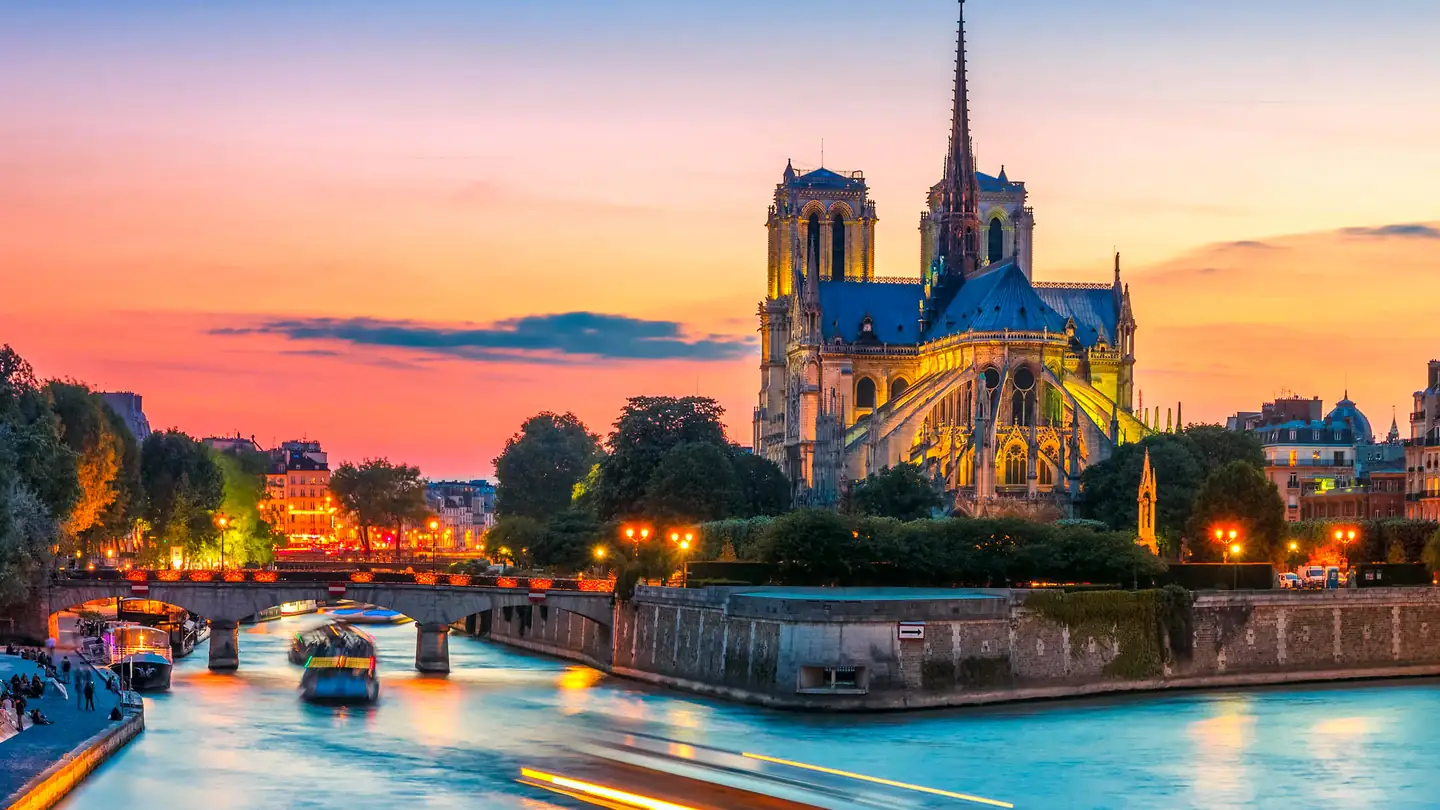
A self-guided loop around the island where Paris began — Point Zéro, the flying buttresses, Sainte-Chapelle's light, Marie-Antoinette's cell and the oldest “new” bridge in Paris.
Stand on the square in front of Notre-Dame de Paris and you are standing on mud. On two thousand years of it — packed, paved and built over stone by stone, until a swamp in the river became the center of France.
The Île de la Cité is shaped like a boat and sits in the middle of the Seine, and it is the reason Paris exists at all. Before the Eiffel Tower, before the boulevards, before the word "Paris," a tribe called the Parisii lived here on a fortress made of water. Everything else grew outward from this island.
You can hear all of it on the spot: the self-guided TouringBee audio tour of Notre-Dame de Paris and the Île de la Cité narrates the island as you walk it, from the Roman mud to Point Zéro — 31 stops, fully offline, so you won't be hunting for signal on the bridge.
This route walks the whole island in a loop you can finish in a day. Every stop carries a story most people pass without a glance. You'll cross the city's oldest bridge, stand on the point from which every distance in France is measured, and find the best stained glass in Paris behind a security screening.
For the cathedral at the island's heart, see our Ultimate Guide to Notre-Dame de Paris. This page is the walk around it.
To avoid crossing the island back and forth, walk it in this order:
Without going inside the paid interiors, the loop takes about two to three hours. Add the crypt, Sainte-Chapelle and the Conciergerie and it becomes a full day.
Start with the island itself: it's the story that came before any monument on it.
In the third century BCE, wooden houses, workshops and shrines belonged to the Gauls who called themselves the Parisii. The Seine curled around them like a moat — a natural fortress, and on a river that carried boats from the British Isles into the heart of the continent. That is exactly why the Romans wanted it.
Taking it in the first century BCE, they named their town Lutetia Parisiorum. The name carries a small sneer: the Latin lutum means mud, or swamp. The mud of the Parisii. The Romans looked at this soggy little island and named it after the slop — with no idea it would become one of the great capitals of the world.
Think of the stone that had to be barged in and packed down to turn a swamp into solid ground. You're walking on all of it.
Lutetia grew fast on trade: stone houses, temples, an arena, baths, bridges. Then the Franks came in the fifth century, the island filled with churches and timber houses, and by the twelfth century there was supposedly nowhere left to build. There was. On the site of a humble church of Saint-Étienne — which stood on a Roman temple, which stood on a Gaulish shrine — Paris raised its cathedral. Work began in 1163 and ran for almost two centuries.
The wide square in front of the cathedral is the parvis. It looks like a calm plaza of street performers and pigeons. It is also, technically, the center of the country.
Look down. Somewhere near the middle of the square, set into the pavement, is a small bronze octagon with a compass rose. This is Point Zéro des routes de France — kilometer zero. Every road distance from Paris to any town in France is measured from here. When a sign says "Lyon 460 km," that's 460 km from the spot under your feet.
There's a ritual, and locals will tell you it works. Stand on the disc. Make a wish. Jump and spin a full turn clockwise, trying to land back on the bronze. Manage it and the wish is on its way. Nobody quite knows where the tradition came from — the marker was only laid in 1924, so it's all surprisingly young. But the queue of tourists spinning like slightly embarrassed ballet dancers is real. Try it.
The square keeps a darker memory too. Long before the bronze disc, a three-sided pillar stood here from 1767. It measured distances — and criminals were chained to it. A milestone and a pillory in one. The medieval square was ringed by worse: the Court of Miracles (Cours des Miracles), the shadow quarters by Notre-Dame where beggars, thieves and vagrants lived. By day they crowded the cathedral steps performing their "afflictions" — limps, blindness, missing limbs — begging for coins. By night, back in their closed courtyards, they worked miracles: the lame walked, the blind saw, every ailment cured by morning. Because none of it was real. Victor Hugo put one such court in The Hunchback of Notre-Dame. The elegant open square you're standing on was bought at the price of all that grubby theatrical underworld.
A practical note, straight from the descendants of those beggars: a few miracles still happen here. Keep a hand on your wallet and ignore anyone with a "petition" clipboard or "cathedral tickets." Entry to Notre-Dame de Paris is free. There is no ticket.
If you want to climb the towers, that's a separate story and a separate ticket: €16, and tickets are sold online only — there is no box office on site. The towers reopened on 20 September 2025. It's 424 steps up, 69 m high, with passages that pinch to 45 cm and spots where you duck. There's no toilet or water inside, so bring a bottle. Groups are capped at seven, and everyone needs their own e-ticket.
You've read about the mud and the Roman stone. Now you can look at it. The entrance to the Archaeological Crypt of the Île de la Cité (Crypte archéologique) is set into the parvis itself, at the western edge of the square: an ordinary staircase down into the ground you were just walking on.
Under the pavement lie the real remains of an earlier Paris: fragments of the Roman rampart, medieval cellars, stretches of quay, the outlines of ancient streets and rooms, layered over each other across centuries. It's the clearest way to physically grasp what the island's history means — today's ground level hangs several meters above the Lutetia the Romans built, and people in togas really did walk these lanes. Lighting and panels help you read the tangle of walls.
Practical: €11 full, €9 reduced. Open Tuesday to Sunday, 10:00–18:00, closed Monday; you book a free timed slot online in advance, as the ticket alone doesn't grant entry, and the visit takes 30–45 minutes. Note: the crypt is currently closed for restoration, so check before you go. When it reopens, it's a strong, quiet, uncrowded choice, and tickets are available through Tiqets.
It's easy to buy too many tickets on this island and spend most of the day inside security checks and queues.
If you have about three hours, pick just one paid sight:
For a first visit on a clear day, we'd choose Sainte-Chapelle. The crypt suits archaeology lovers, the Conciergerie suits Revolution history, and the towers suit anyone ready for 424 steps.
Small-group and private tours of Notre-Dame and the Île de la Cité — a live guide instead of guesswork.
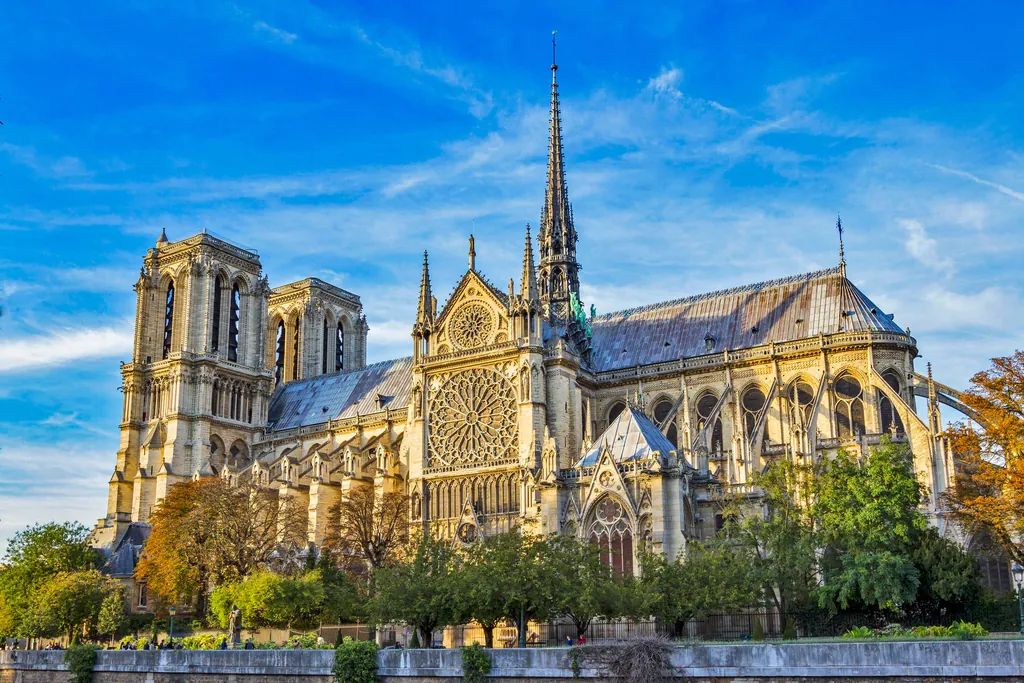
Walk along the south side of the cathedral to its eastern end and you reach the Jardin Jean XXIII, behind the apse. Most people photograph the famous west facade and never come back here. A pity: this is the best view of the building.
From the garden you look straight up at the flying buttresses — the great stone arches springing from the walls like ribs.
They're not decoration. Gothic builders wanted walls made almost entirely of glass, but glass and thin walls can't hold a heavy stone roof. So the weight has to be carried outward, onto external arches — strong shoulders that push the cathedral up and hold it straight. From the Jardin Jean XXIII the engineering is right in front of you, and behind it rises Viollet-le-Duc's spire, its base climbed by twelve apostles. It's the shot people later wish they'd taken. Free, and usually calm.
Then walk to the island's easternmost tip, past the garden. Here, half-hidden and easily missed, is the Memorial of the Martyrs of the Deportation (Mémorial des Martyrs de la Déportation), for the 200,000 people deported from Vichy France to the Nazi camps.
You descend a narrow staircase into a tight space behind the walls, cut off from the river and the noise. Inside, a long corridor is lined with 200,000 small lit crystals — one for each person deported — receding into the dark. Free, deliberately cramped, and very heavy. Give yourself a few minutes of silence. It's one of the most powerful places on the whole island, and one of the least visited.
Head back west, to the middle of the island, and the mood changes completely. The Marché aux Fleurs Reine Elizabeth II is a covered flower market that has traded on this spot since the early nineteenth century — one of the last of its kind in Paris. It sits between the cathedral end of the island and the law-courts complex, steps from the Cité metro.
Under cast-iron pavilions: orchids, roses, ferns, seedlings, watering cans and garden clutter spilling into the aisles. The market was renamed for Queen Elizabeth II after her visit in 2014. It's free to wander, it smells wonderful, and it's a human-scale green breather between the cathedral crowd and the big monuments ahead.
If Notre-Dame de Paris is a mountain of stone, Sainte-Chapelle is a lantern. It's a five-minute walk from the cathedral, set in the courtyard of the law courts, and nothing outside prepares you for what's inside.
King Louis IX — Saint Louis — built it in the 1240s for one purpose: to house the Crown of Thorns, a relic bought for a sum that swallowed a huge share of France's annual budget. The relic outshone any building, so the building had to become worthy of it. (The crown later moved to Notre-Dame's Treasury, where it survived the 2019 fire.)
The chapel has two floors. The lower one, low and dim, was for palace staff. Climb the tight spiral stair to the upper chapel and the walls simply vanish.
Up here there's almost no stone: 15 towering stained-glass windows and a rose, more than 1,100 biblical scenes told in glass, most of it original thirteenth-century work. On a clear day the room glows from within like a jewel — walls of blue, red and gold with daylight pouring straight through them. The glass-to-stone ratio is far higher than at Notre-Dame; the medieval builders were showing what Gothic could really do.
For a full comparison of the two buildings, see Notre-Dame vs Sainte-Chapelle.
Practical — and read this carefully. Since 12 January 2026, the Centre des monuments nationaux charges different prices by nationality and residency:
| Ticket | EEA citizens/residents (4+ months) | Everyone else |
|---|---|---|
| Sainte-Chapelle | €16 | €22 |
| Sainte-Chapelle + Conciergerie | €23 | €30 |
The EEA is the 27 EU countries plus Liechtenstein, Iceland and Norway. If you don't hold citizenship or residency in one of them, you pay the right-hand column — budget for it. Hours: daily 9:00–19:00 (April–September) or 9:00–17:00 (October–March). Security is shared with the working law courts, airport-style, so the queue can be long and unpredictable. Take a timed slot in advance — it's mandatory even for those who enter free — through Tiqets or GetYourGuide.
Timed tickets for Sainte-Chapelle and the Archaeological Crypt — booked ahead, straight past the shared security line.
Next door, on the same combined ticket, is the Conciergerie. The mood is the exact opposite of Sainte-Chapelle's light.
It was once part of the medieval royal palace, and its vast Hall of the Men-at-Arms (Salle des Gens d'Armes) is a cavern of Gothic vaults, one of the largest surviving secular medieval halls in Europe. But the building is remembered for what it became during the Revolution: a prison and the antechamber to the guillotine.
Thousands passed through it on their way to execution. The most famous prisoner was Marie-Antoinette, held in a cell for several weeks before her death in 1793. You can visit the memorial chapel on the site of her cell and see reconstructions of how prisoners lived — or rather, how briefly they lived, while the Revolutionary Tribunal decided their fate.
History is at its rawest here: on the same island where a ten-year-old English king was once crowned inside Notre-Dame, a few hundred meters away a nation queued its own aristocracy up for the blade.
Practical: about €13 for an adult, or the combined ticket with Sainte-Chapelle (€23 / €30, see the table above). Allow about an hour. A timed slot is mandatory only for Sainte-Chapelle — the Conciergerie you can enter any time during opening hours. Tickets through GetYourGuide or Tiqets.
After the Conciergerie, keep walking west and turn into Place Dauphine. It was created in the early seventeenth century under Henri IV, originally in an almost perfect triangle. Behind the house fronts hides a surprisingly quiet space of trees, benches, cafés and pétanque courts. After the security checks of Sainte-Chapelle and the heavy history of the Conciergerie, it's a good place for a short pause. Walk straight through — its narrow western tip leads out to the equestrian statue of Henri IV and Pont Neuf.
Finish at the western tip of the island, where it narrows to a point.
Step onto Pont Neuf — the "New Bridge," which is in fact the oldest standing bridge in Paris, completed in 1607. The joke stuck: when it opened it was radically new — the first Paris bridge with no houses on it, and the first with pavements, so people could finally walk and watch the river instead of squeezing between shops. Four centuries later, everyone still calls the oldest bridge the new one.
From the middle of Pont Neuf, a staircase drops to the Square du Vert-Galant, a small triangular park at water level on the very prow of the island. It's the lowest public point on the Cité, right where the two arms of the Seine meet again. Sit on the grass under the willows: the river splits around you, the sun goes down behind the western bridges. It's the best free sunset on the island and a natural place to end the walk. The park is named — with a wink — after the "vert galant," the nickname of the amorous King Henri IV, whose statue stands on the bridge above.
The loop is closed. To carry on, cross the short Petit Pont from the cathedral end of the island to the Left Bank, and you're straight into the Latin Quarter — the old Roman student district of arenas and baths that Etienne, the audio guide's narrator, keeps promising to show you.
It's the most natural continuation of the walk: the same Roman city you saw fossilized in the crypt, but above ground and alive, with bookshops, cafés and Sorbonne students. The TouringBee Latin Quarter tour in the same app picks up the story across the river. In the other direction, north, the Right Bank and the Hôtel de Ville are one bridge away.
The Île de la Cité doesn't give up its stories on its own — you have to know where to stand. Let old Etienne, the cathedral's gargoyle-maker, walk you around it stop by stop, from the Roman mud to sunset on Pont Neuf: 31 stops, ~2 hours, 10 languages, fully offline, one year of access.
Start the audio tour — from €9.99Some links are partner links (Tiqets, GetYourGuide). The price is the same for you; we may earn a small commission.
