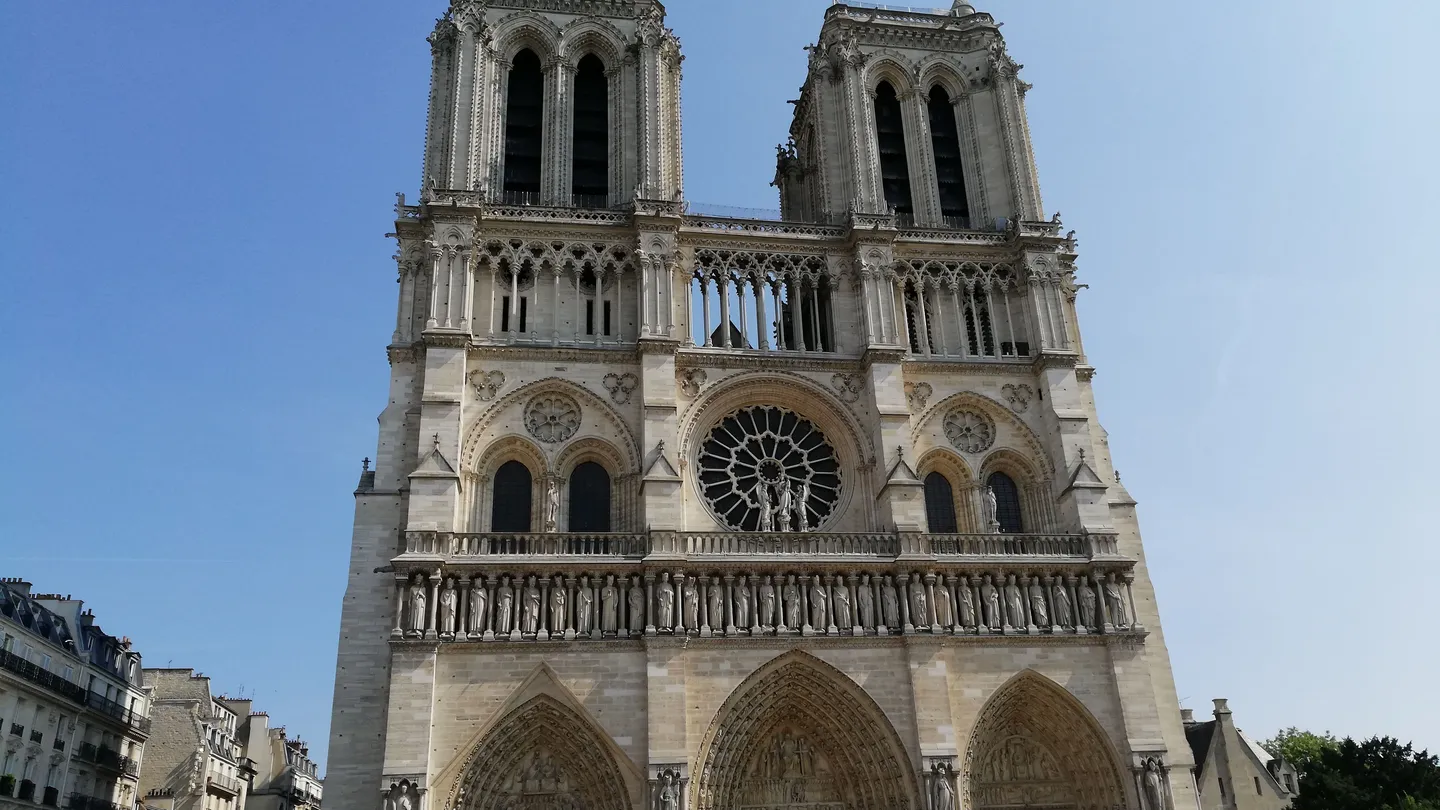
Jupiter beneath the cathedral floor, Joan of Arc's mother at the altar, kings' heads that lay buried for almost two centuries, and a general who didn't duck under fire.
Notre-Dame's history is usually told as a list: 1163, the first stone is laid; 1345, construction is finished; 1804, a coronation; 2019, the fire. All true — but a list like that misses the point. It can't tell you why this cathedral kept ending up at the centre of events, or how it managed to outlive everyone who tried to remodel it, loot it or burn it.
So we're telling the story differently — through people and moments. A bishop from a poor family who dreamed up a church of unheard-of size. A mother who came to the cathedral to clear her daughter's name. Stone heads of kings that lay buried for almost two hundred years in the very heart of Paris. A general who didn't duck when shots rang out beneath the vaults.
Many of these stories have left traces you can still see today. The TouringBee audio guide helps you find them on the spot: it takes you around the cathedral and inside it, and 13 of its 31 stops are outside, so you can start while you're still on the square.
| When | What happened | What you can see today |
|---|---|---|
| 1st century | The boatmen of Lutetia raise a pillar to Jupiter | The pillar — at the Musée de Cluny |
| 1163 | Maurice de Sully starts building | The tympanum of the St Anne Portal |
| 1258 | Architect Jean de Chelles signs his name in stone | The south portal — from a distance |
| 1302 | The first Estates General meet in the cathedral | Story only |
| 1455 | Joan of Arc's mother demands a retrial | Joan's statue inside |
| 18th century | The canons swap the stained glass and cut up a portal | The central portal |
| 1793 | The Revolution beheads the Gallery of Kings | The heads — at the Musée de Cluny |
| 1804 | Napoleon is crowned amid stage scenery | David's painting — at the Louvre |
| 1844–1864 | Restoration after Hugo's novel | Chimeras, spire, statues |
| 1944 | Shots under the vaults during the Magnificat | Story only |
| 2019–2024 | The fire and a five-year rebuild | The new spire and bright vaults |
In the early 18th century, workmen digging a burial vault for the archbishops of Paris beneath the cathedral floor came across stone blocks carved with reliefs and a Latin inscription. It said the pillar had been dedicated to Jupiter by the "boatmen of Paris" — the guild of river merchants of Gallo-Roman Lutetia — in the reign of Emperor Tiberius, in other words in the first half of the 1st century.
So it turned out that, long before Notre-Dame, the Île de la Cité was already a sacred place. On those blocks, Roman gods stand side by side with Celtic deities, among them the antlered god Cernunnos. It's one of the oldest monuments in Paris, dating from a time when the city was still called Lutetia. Later, in the 6th century, a huge cathedral, Saint-Étienne, stood on this spot. Its foundations were found in the 19th century beneath today's square.
In other words, Notre-Dame grew up on a spot where people had already been praying for more than a thousand years.
See it for yourself: the Pillar of the Boatmen — at the Musée de Cluny, a 10-minute walk away; remains of the ancient city — in the archaeological crypt under the square (admission charged).
Maurice de Sully was born into a poor family — according to tradition, a peasant one — not far from the Loire. He came to Paris to study, became a celebrated preacher and, in 1160, Bishop of Paris. Three years later he launched a building project that would outlive him by a century and a half.
The ambition was unheard of: the new cathedral was meant to be one of the largest in Christendom. Sully cleared the site, pulled down old buildings and laid out a new street so that stone could be hauled up from the Seine. According to tradition, the first stone was laid by Pope Alexander III, who was living in France at the time. Historians aren't sure about that, but the legend has held for eight centuries.
Sully himself died in 1196. By then the choir and part of the nave were finished, but work hadn't yet reached the façade. The cathedral took almost two hundred years to build. Generation after generation of masons came and went, and most of them never saw it finished.
See it for yourself: up close — the right-hand portal of the west façade, the St Anne Portal. On the tympanum, next to the Virgin, stands a bishop, and tradition holds that he is Maurice de Sully himself.
We know almost nothing about the people who built Notre-Dame. Medieval master builders rarely signed their work: a cathedral was raised for the glory of God, not of its architect. That makes one exception all the more precious. At the base of the south transept portal, an inscription is carved into the stone: the work was begun by master Jean de Chelles on 12 February 1258. For the period, it's a rare case of an architect leaving his name right on the building.
His work was carried on by Pierre de Montreuil, one of the most famous architects of his day. It was under these two men that the cathedral gained its huge transept roses. Notre-Dame was also one of the first great cathedrals whose walls were braced from outside by flying buttresses — stone "arms" that hold up the vaults and allow thinner walls and taller windows.
And here's something people rarely remember: in the Middle Ages, the façade was colourful. The portal sculptures were painted, and when restorers cleaned the stone they found traces of pigment. A white Notre-Dame is our own, modern way of seeing it.
See it for yourself: the flying buttresses — up close, from the south side and from the garden behind the apse; the south portal with the inscription — only from a distance, from the riverside quay.
On 10 April 1302, Philip IV the Fair summoned representatives of the clergy, the nobility and — for the first time — the townspeople to Notre-Dame. The king was in open conflict with Pope Boniface VIII over who had the final say in France, the Crown or Rome. Philip needed to show that the whole country stood behind him — and, while he was at it, to find money for his war in Flanders.
This assembly is regarded as the first Estates General. Over the following centuries they were summoned, then forgotten, then summoned again; they met for the last time in 1789 — and that's where the Revolution began. So the story that ended with the fall of the monarchy began beneath the vaults of Notre-Dame.
See it for yourself: story only.
Download link sent to your email right after purchase · the guide works for 1 year · questions? support@touringbee.com
Get the Audio Guide — €6.99Notre-Dame audio guide: route, stops & what's inside →In 1431, Joan of Arc was burned at the stake in Rouen as a heretic. Twenty-four years later, on 7 November 1455, an elderly woman walked into Notre-Dame — her mother, Isabelle Romée. She was over seventy. Before the Pope's envoys she gave a speech that began with the words: "I had a daughter, born in lawful wedlock…"
That day marked the start of the retrial of Joan's case. Eight months later, the verdict was overturned. Her mother lived to see the day her daughter officially ceased to be a heretic. Joan was only declared a saint in 1920, and today her statue stands inside the cathedral.
In fact, Notre-Dame was the stage for royal events more than once. In December 1431, six months after Joan's execution, a ten-year-old English boy, Henry VI, was crowned King of France here. In 1558 the young Mary Stuart married the heir to the French throne, Francis, in the cathedral. And yet another royal wedding took place literally at the cathedral's doors — but we're saving that story for the audio guide: it's best heard standing on the very spot.
See it for yourself: the statue of Joan of Arc — up close, inside, in the south-west corner, by the exit.
It's generally said that Notre-Dame suffered at the hands of the revolutionaries. That's true, but by 1789 the cathedral had already been "modernised" by its own custodians. In the 18th century anything medieval looked crude and gloomy, and the chapter decided to let in more light. From 1741, the Le Vieil brothers, master glaziers, replaced a great many of the medieval stained-glass windows with almost clear glass. The main survivors were the three great roses.
Even earlier, at the start of the century, the choir was remodelled to fulfil a vow made by Louis XIII, and in the process the medieval screen separating the choir from the nave was torn down. Then, in 1771, the architect Soufflot removed the central pillar of the main portal, together with its statue of Christ, and cut away the lower part of the Last Judgement tympanum. The reason was purely practical: the canopy carried in processions had to fit through the portal.
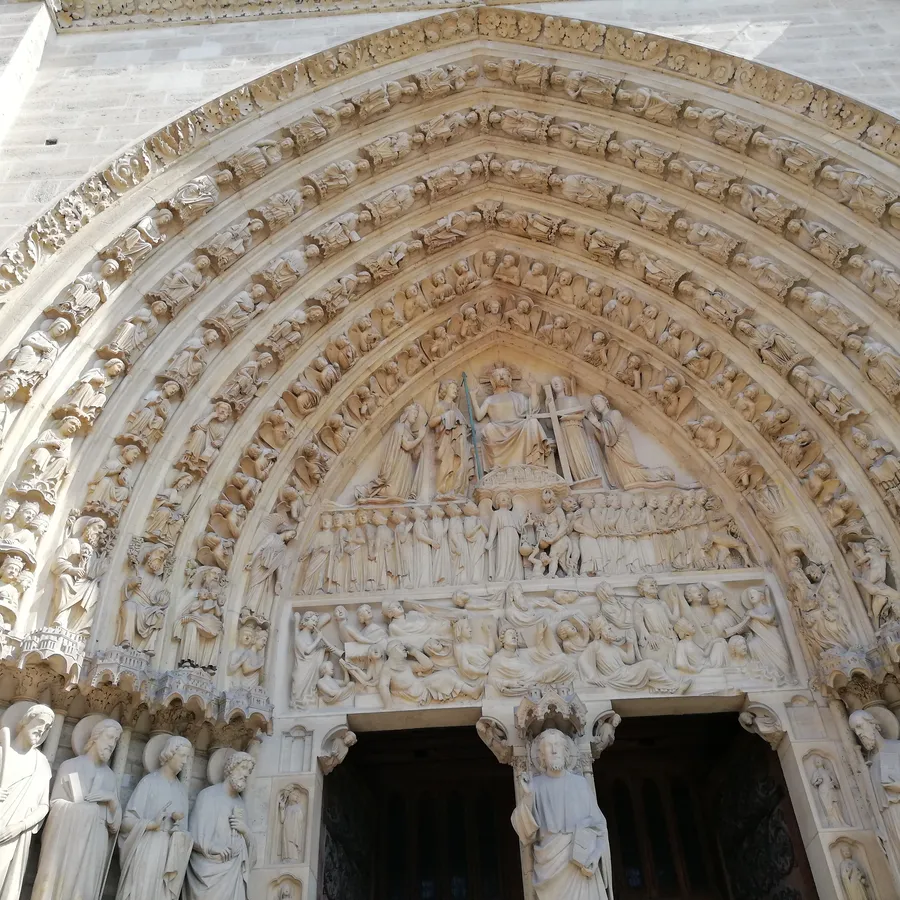
The portal wasn't restored until the 19th century. So the Christ who greets you at the central entrance today is the work of Viollet-le-Duc's workshop, not of medieval carvers.
See it for yourself: up close — the central portal of the west façade. Look carefully at the tympanum and you'll spot where medieval stone meets 19th-century restoration.
A gallery of 28 statues runs above the portals. They are the kings of Judah, the ancestors of Christ. But in 1793 the revolutionaries decided they were kings of France, so the statues were beheaded and thrown to the ground. Around the same time, the cathedral was turned into a Temple of Reason and later used as a warehouse — wine included. There's more on this in our Notre-Dame legends.
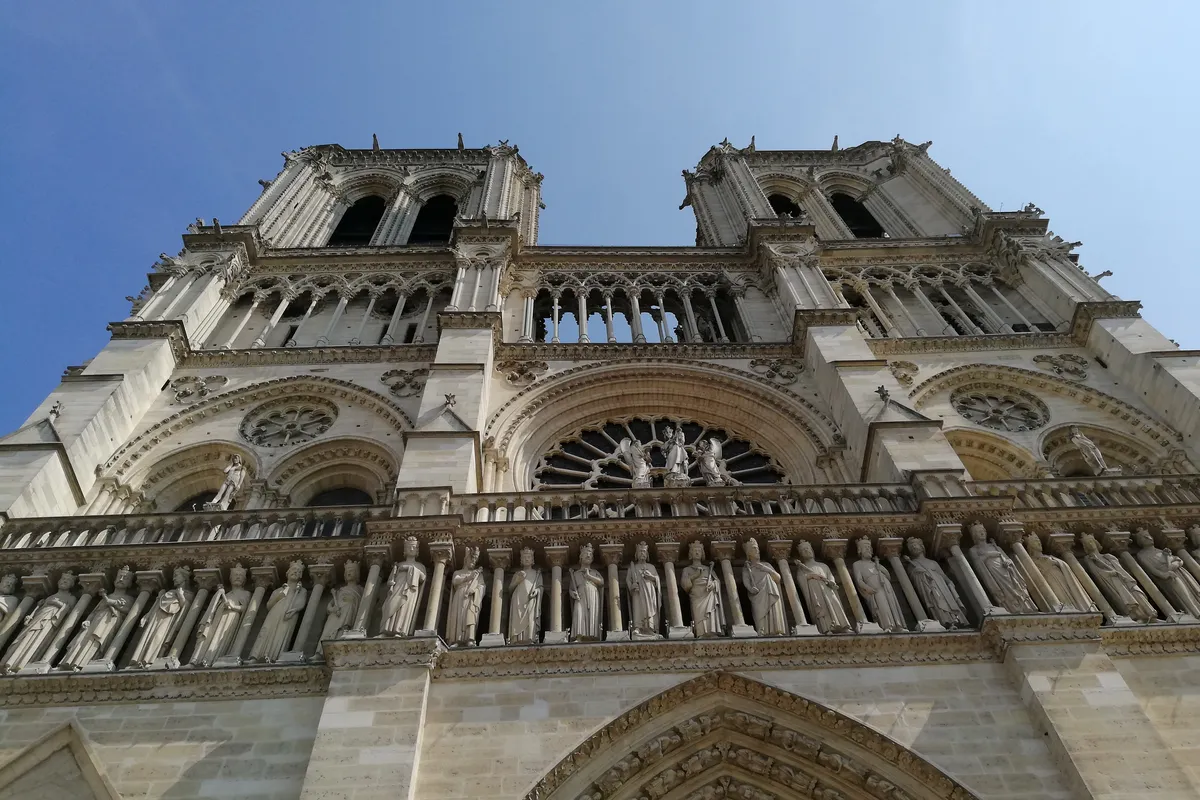
The heads vanished for almost two centuries. In 1977, during renovation work on a mansion in the 9th arrondissement that housed a bank at the time, workers found 21 stone heads buried in the ground. They were the kings from Notre-Dame's façade. According to the most popular version, the owner of the house secretly buried them after the Revolution because he couldn't bear to see them end up on a rubbish heap. Why he really did it is still debated.
Today the heads are on display at the Musée de Cluny, while the façade holds 19th-century copies. Some of the originals still show traces of paint — further proof that the medieval façade was colourful.
See it for yourself: the Gallery of Kings — up close, from the square; the original heads — at the Musée de Cluny.
When Napoleon decided to have himself crowned, Notre-Dame was in a sorry state after the Revolution. There was no time for repairs, so the cathedral was simply dressed up. The architects Percier and Fontaine attached a neo-Gothic portico of wood, cardboard and plaster to the façade, had the walls inside whitewashed, draped the columns in fabric and tapestries, and built stands for the guests in the choir.
On 2 December 1804, in the presence of Pope Pius VII, Napoleon placed the crown on his own head and then crowned Josephine. Jacques-Louis David captured the scene on a gigantic canvas that now hangs in the Louvre. The interior in the painting is Notre-Dame in its festive costume, not the real medieval cathedral.
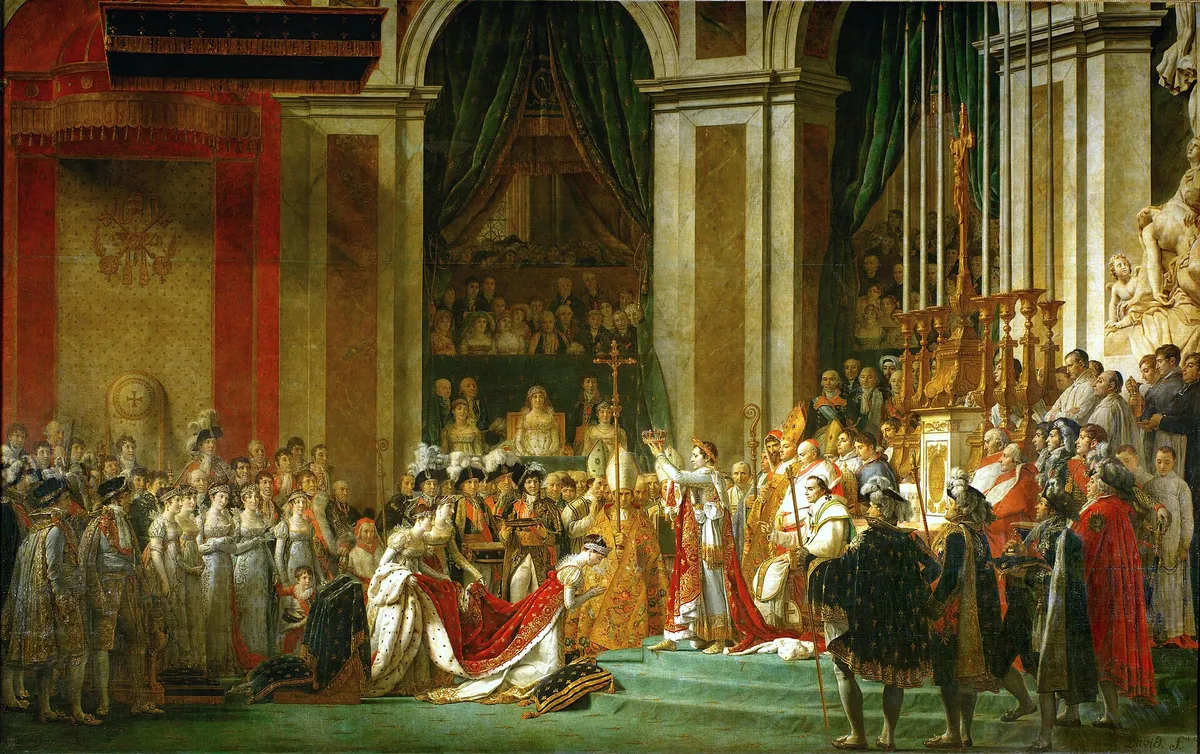
See it for yourself: story only; the painting "The Coronation of Napoleon" — at the Louvre, a 20-minute walk away.
By the 1830s Notre-Dame looked abandoned: smashed statues, empty niches, crumbling stone. The medieval spire had been dismantled back in the late 18th century, and for more than half a century the cathedral stood without one. In 1831 Victor Hugo published his novel "Notre-Dame de Paris", known in English as "The Hunchback of Notre-Dame". In a sense, the book's real hero was the cathedral itself, and after reading it Parisians saw the building with new eyes. Hugo also openly called for a stop to those who were tearing down old Paris — he even wrote a pamphlet titled "War on the Demolishers".
In 1844 the state launched a competition for the restoration. It was won by Jean-Baptiste Lassus and the young Eugène Viollet-le-Duc. The work dragged on for twenty years. Statues and portals were restored, chimeras that had never existed in the Middle Ages were added, and by 1860 a new spire was in place. At its foot, Viollet-le-Duc set statues of the apostles — and gave one of them, St Thomas, his own face. In April 2019 these statues were taken down for restoration four days before the fire, and that's what saved them.
Around the same time, under Prefect Haussmann, the medieval neighbourhoods around the cathedral were demolished. The square in front of Notre-Dame became several times larger, and only from then on did the cathedral stand in the open, with space all around it. Today it's hard to imagine how hemmed in by houses it used to be.
See it for yourself: the chimeras — from the towers (separate ticket required); the new spire, a replica of Viollet-le-Duc's — from a distance, best from the Pont de la Tournelle or the garden behind the apse.
On the evening of 24 August 1944, as the first units of Leclerc's division entered Paris, Notre-Dame's great bell, Emmanuel, began to ring. Bells across the whole city joined in: that's how Parisians learned that the liberation had begun.
Two days later, General de Gaulle came to the cathedral for a service of thanksgiving — the Magnificat. He had barely stepped inside when shots rang out, both inside and out. People threw themselves to the floor, while de Gaulle walked on down the nave without quickening his pace or ducking his head. Who fired has never been fully established. A radio recording of the moment survives — you can hear the shots on air.
It wasn't the first time the cathedral had found itself in the line of fire. In May 1871, in the last days of the Paris Commune, while the Tuileries and the Hôtel de Ville were burning, there was, according to several accounts, an attempt to set Notre-Dame alight from the inside too: chairs and benches were piled up and set on fire. The flames were quickly put out. Who did it and why — accounts still differ to this day.
See it for yourself: story only; the Emmanuel bell hangs in the south tower, and you can see it when you climb the towers.
Notre-Dame is the main Catholic cathedral of Paris, yet it doesn't belong to the Church. Under the 1905 law on the separation of Church and State, cathedrals built before that year became state property. The Church uses them free of charge and indefinitely, while upkeep and security are the state's responsibility.
That's why, after the fire of 15 April 2019, the restoration was led by the state rather than the diocese. The flames destroyed the roof and the spire, but the stone vaults largely held. Five years and eight months later, in December 2024, the cathedral reopened. Today you'll find it bright inside: the stone has probably not been this clean for several centuries. For the full story of that night and the rebuild, read our article on the Notre-Dame fire.
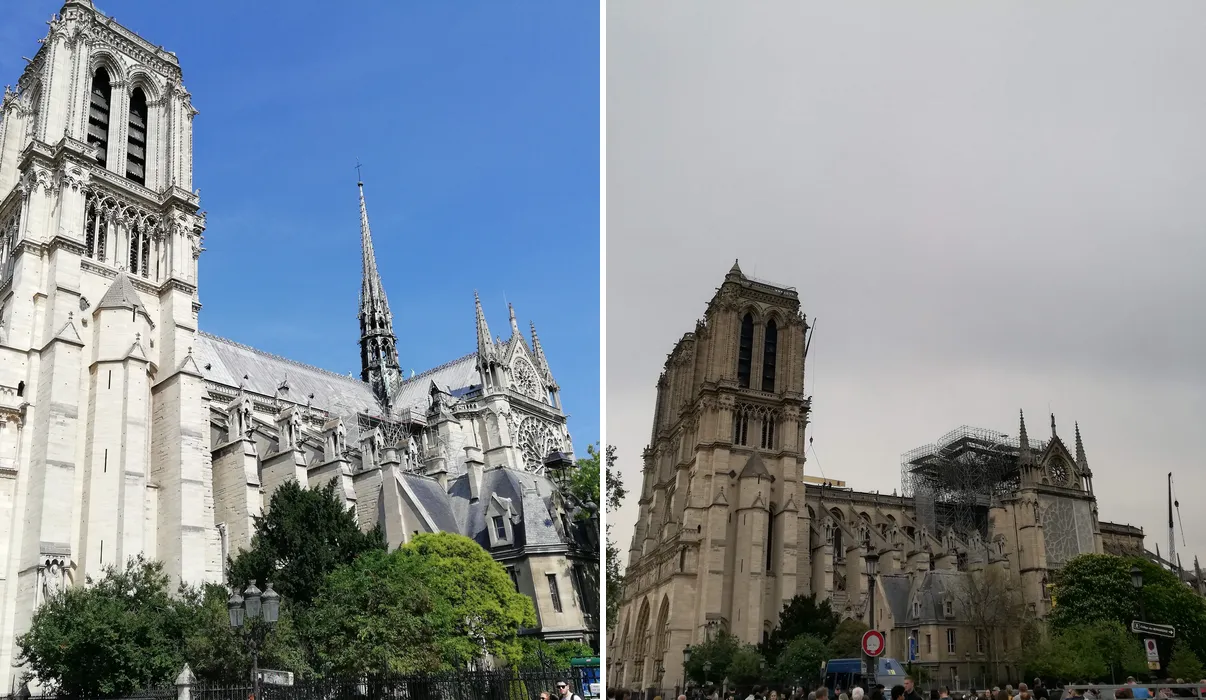
See it for yourself: the result — the whole cathedral: the new spire, the cleaned vaults and stained glass.
Small-group and private Notre-Dame tours — a good option if you'd rather ask questions in real time.
How long did it take to build Notre-Dame?
Almost two centuries: construction began in 1163, and the main work was finished around 1345. Several generations of craftsmen worked on the cathedral.
Who built Notre-Dame?
Construction was started by Bishop Maurice de Sully. The names of the first master builders are unknown. Among the later architects, we know of Jean de Chelles, who left an inscription on the south portal, and Pierre de Montreuil. In the 19th century the cathedral was restored by Jean-Baptiste Lassus and Eugène Viollet-le-Duc.
How old is Notre-Dame?
The first stone was laid in 1163, so the cathedral is more than 860 years old. But much of what you see is younger: the chimeras, the spire and many of the statues and stained-glass windows date from the 19th to the 21st centuries.
What was damaged during the Revolution?
The statues of the Gallery of Kings and of the portals, many treasures and bells. The cathedral was turned into a Temple of Reason and then used as a warehouse. The kings' heads weren't found until 1977.
Who owns Notre-Dame?
The state. Under the 1905 law, the cathedral is the property of France, and the Church uses it free of charge. That's why the restoration after the 2019 fire was run by the state.
Start the audio guide on the square, by the Gallery of Kings — and finish it inside, beneath the vaults where Napoleon was crowned.
Get the audio guide — €6.99The GetYourGuide tour link is a partner link: the price is the same for you, and we may earn a small commission. The audio guide is provided by TouringBee.
