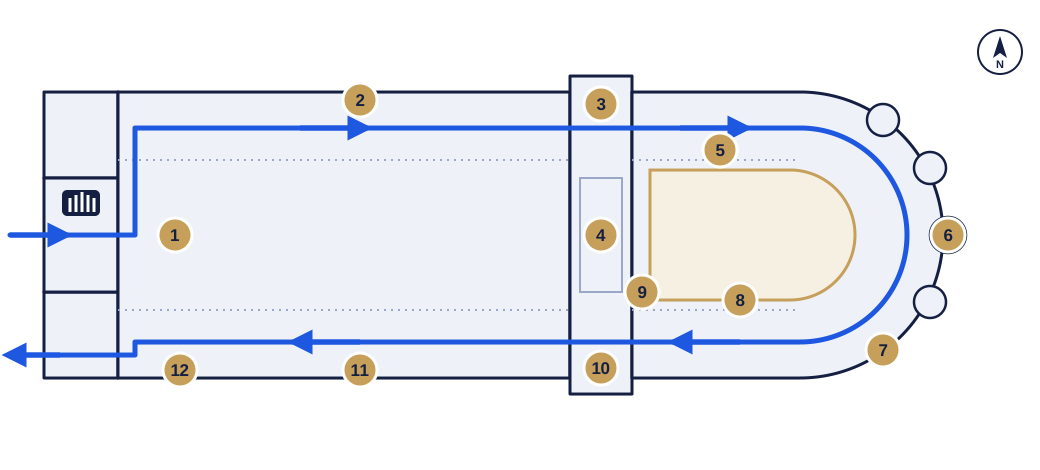
Twelve stops along today's visitor route — the goldsmiths' paintings, the rose windows, the choir where an English boy was crowned king of France, the Crown of Thorns, the oldest fresco, the great organ — with a plan, where to find each one and the story behind it.
Many visitors make do with a quick 20–30-minute loop of Notre-Dame. They come in, look up, take the photo everyone takes, follow the crowd round and leave — having walked past the oldest painting in the cathedral, the spot where an English boy was crowned king of France, and a statue that turned an atheist poet into a believer on Christmas Day.
This guide follows the visitor route as it runs today, with twelve numbered stops you can find on the plan below — where each one is, and the story that makes it worth stopping for. If you'd rather hear the stories while you walk, the TouringBee audio guide covers all of this — and you can start it outside while you wait to get in: 13 of its 31 stops are on the square and around the cathedral, the other 18 inside.
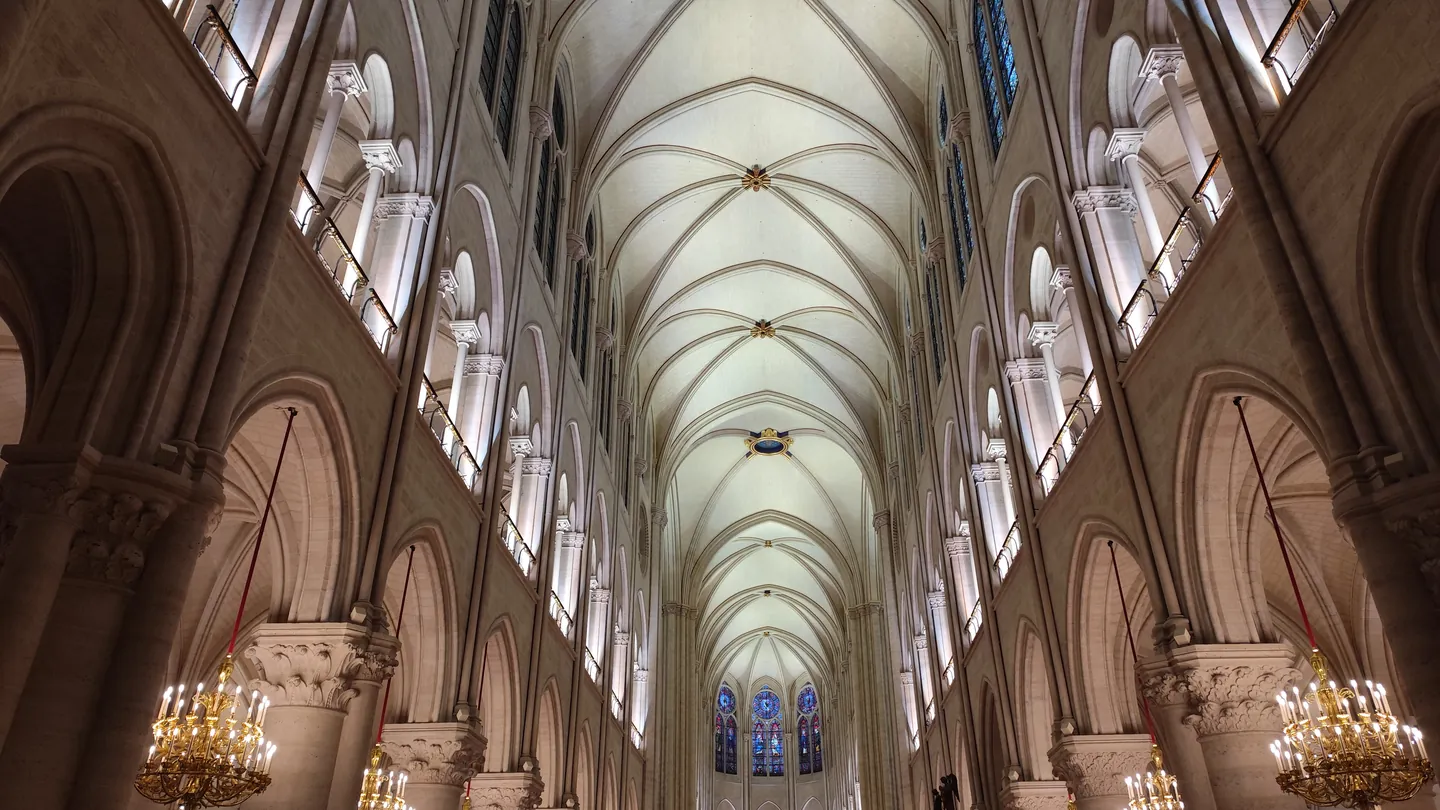
Where: right inside the central portal, before the route turns left.
Picture who this was built for. A medieval Parisian lived in dark, cramped, filthy streets, in houses whose tiny windows were covered with oiled cloth or animal bladder rather than glass. Then he walked in here — and the walls seemed to disappear. Instead of walls there were columns and coloured light, and a vault so high it felt like the sky. That effect was the whole point.
The great hall is called the nave, from the Latin navis, a ship. Look up and the ribbed vault really does resemble an upturned hull: the church as Noah's Ark, carrying souls to safety. Since the restoration it is also brighter than anyone alive has seen it — centuries of candle soot were cleaned off the pale limestone before the 2024 reopening. Far ahead, at the crossing, you can make out the newest object in the building: a bronze altar by designer Guillaume Bardet, made for the reopening.
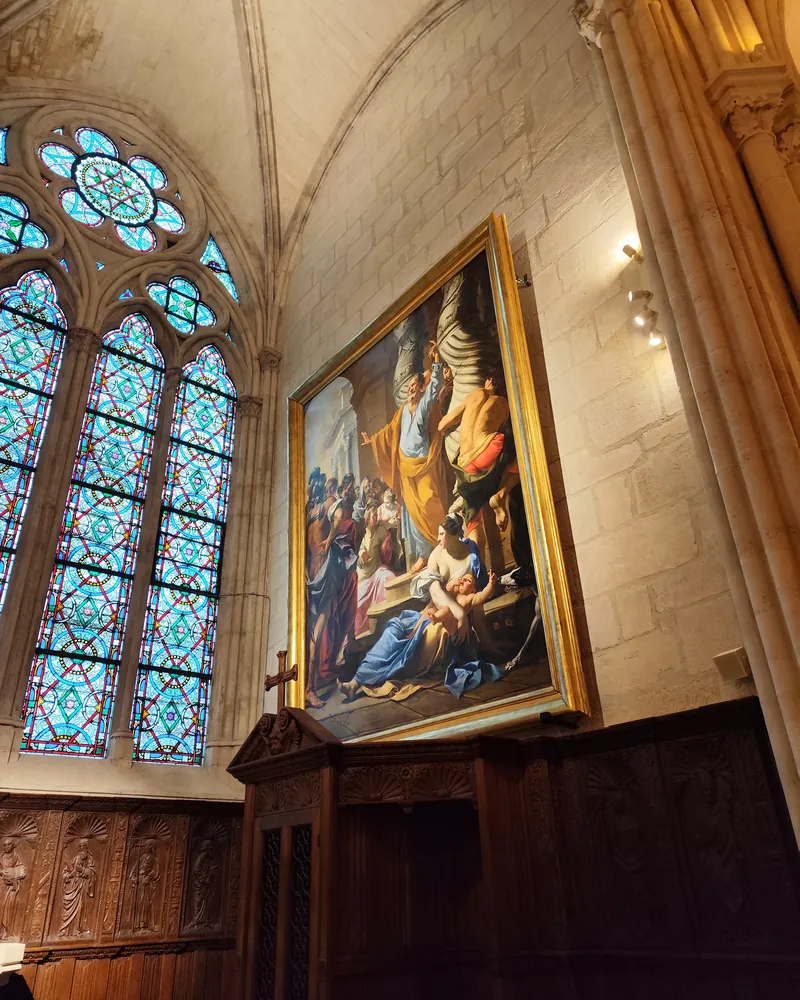
Where: the side chapels on your left as you walk up the north aisle. More of these paintings hang in the south-aisle chapels on the way out.
The small rooms behind the wrought-iron gates are chapels — little churches within the church — and they show how unequal the cathedral was. Noble families and wealthy guilds owned them, prayed in them away from the crowd, and decorated them to show off.
The best story belongs to the Paris goldsmiths' guild. From 1630 to 1707, every year on 1 May, the goldsmiths presented the cathedral with a large painting of a biblical scene — 76 in all, known simply as the "Mays". Many were later dispersed to museums. Thirteen were restored between 2021 and 2023 and rehung in the chapels for the reopening, among them Charles Le Brun's Martyrdom of Saint Andrew and Laurent de La Hyre's Conversion of Saint Paul. Most people walk straight past some of the finest French painting of the 17th century.
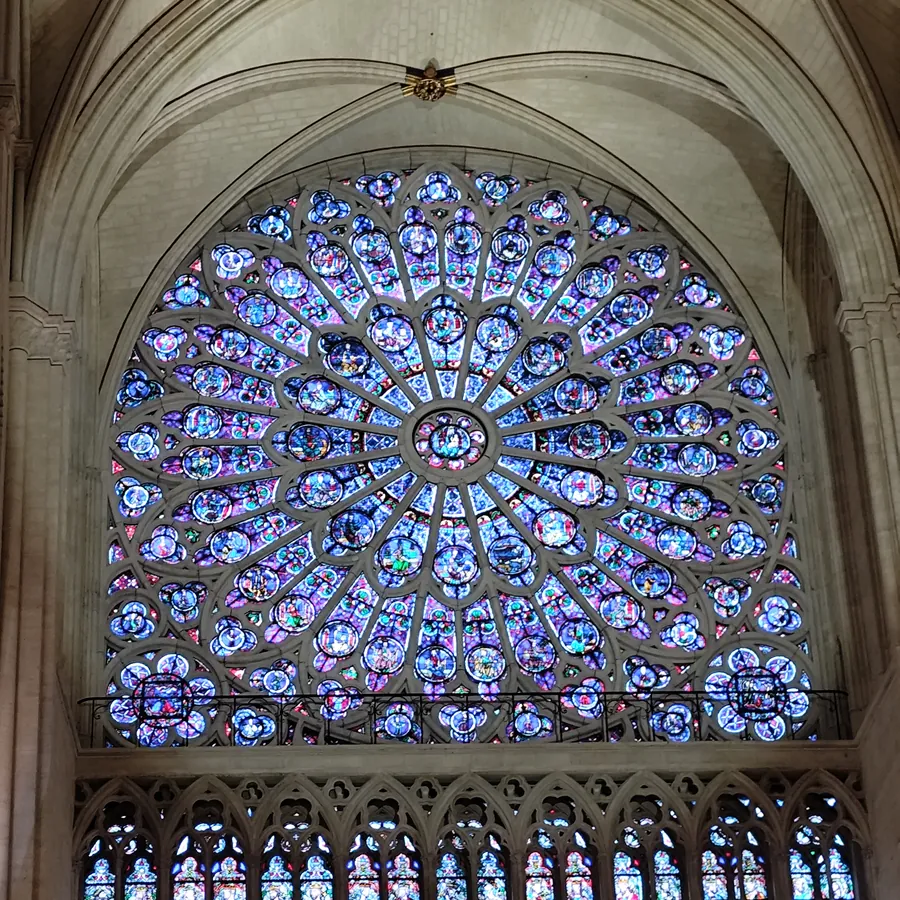
Where: at the end of the north aisle the route enters the north transept — look up. Then look across the crossing: the south rose is directly opposite.
The north rose dates from around 1250 and, at about 13 metres across, is one of the great achievements of Gothic glass. Much of its glass is still medieval — remarkable when you consider that revolutionaries pelted the cathedral's windows with stones in the 1790s, and that in 2019 the roof burned directly above it. All three roses survived the fire. Each colour had a cost: the deep blue came from cobalt, one of the most expensive ingredients a medieval glassmaker could buy. Devoted to the Virgin and the Old Testament, the north rose faces north and is lit by the cool, even light of the sky rather than by direct sun — which is why it reads mostly as blue.
Where: from the north transept, look into the crossing — the bronze altar — and beyond it, the choir.
Notre-Dame seems the obvious place to crown French kings, yet only one king was ever crowned here, and he wasn't French. In 1431, in the middle of the Hundred Years' War, the English crowned ten-year-old Henry VI of England as king of France in this choir, to stake their claim in the heart of Paris. The French ignored it: their kings were crowned at Reims.
The choir saw one more coronation, and a far more famous one. On 2 December 1804 Napoleon was crowned emperor here. The Pope had blessed the crown, but Napoleon placed it on his own head himself — and then crowned Josephine. It's that second moment, Napoleon crowning his empress, that Jacques-Louis David chose for his enormous painting in the Louvre.
Download link sent to your email right after purchase · the guide works for 1 year · questions? support@touringbee.com
Get the Audio Guide — €6.99Notre-Dame audio guide: route, stops & what's inside →Where: the carved wall on your right as you walk east along the north side of the ambulatory, the walkway around the choir.
This low wall encloses the choir, and it is covered with carved, painted scenes from the life of Christ, made in the 14th century to screen the clergy from the bustle of the aisles. It reads exactly like a comic strip: the Nativity, the Flight into Egypt, the Wedding at Cana, the Entry into Jerusalem, the Last Supper. The figures on this side are the older ones, stiffer and more austere; you'll see the difference when you reach the other side. Look at the faces — you can read the emotions on them.
Where: the central chapel at the far east end, directly behind the choir — the chapel of Notre-Dame-des-Sept-Douleurs. You can't miss the tall golden reliquary.
Notre-Dame's most precious relic has an extraordinary back story. In the 13th century the Crown of Thorns was in Constantinople, where a crusader emperor deep in debt to Venetian bankers had pawned it. Louis IX of France bought it for 135,000 livres — a colossal sum, more than three times what the Sainte-Chapelle he then built to house it would cost — and in 1239 he and his brother carried it the last stretch to Sens barefoot. It has been kept at Notre-Dame since the early 19th century, and in 2019 it was carried out of the burning cathedral by a chain of firefighters and clergy.
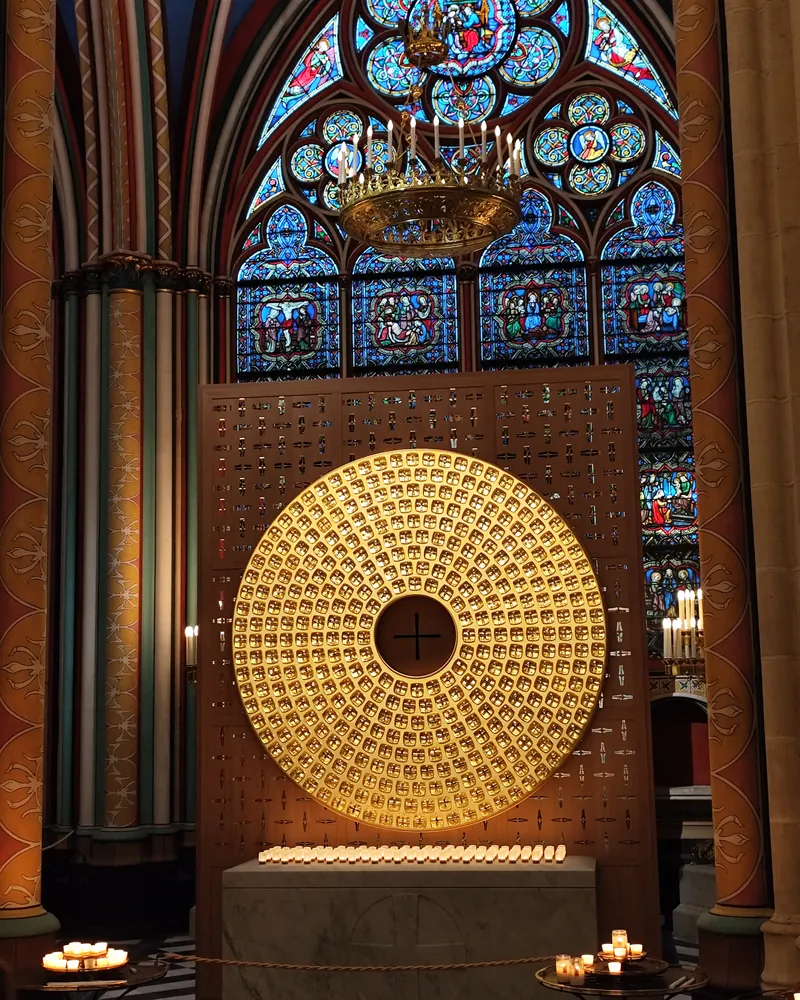
Since the reopening its home is this golden reliquary designed by Sylvain Dubuisson. The relic itself is kept in a safe and brought out for veneration on Fridays — according to the cathedral, on the first Friday of the month from 3 to 5 pm and on other Fridays from 3 to 6.30 pm. Times can change, so check before you plan around it.
Now look at the south (right-hand) wall of the same chapel. The faded mural there is the oldest painting in Notre-Dame: a 14th-century fresco of the Virgin welcoming the soul of Bishop Simon Matifas de Bucy, with Saint Denis and Saint Nicaise beside her. It came through the Revolution that destroyed so much of the cathedral's art — according to the story told about it, because in the 18th century it had been covered by wooden panelling that nobody thought to look behind — and was uncovered during Viollet-le-Duc's restoration in the 19th century.
Where: continue round the apse towards the south side; a few chapels after the axial chapel. Your landmark is Pigalle's dramatic marble tomb of the Count of Harcourt, with a wife reaching for her husband as Death beckons. The kneeling couple is in the same chapel.
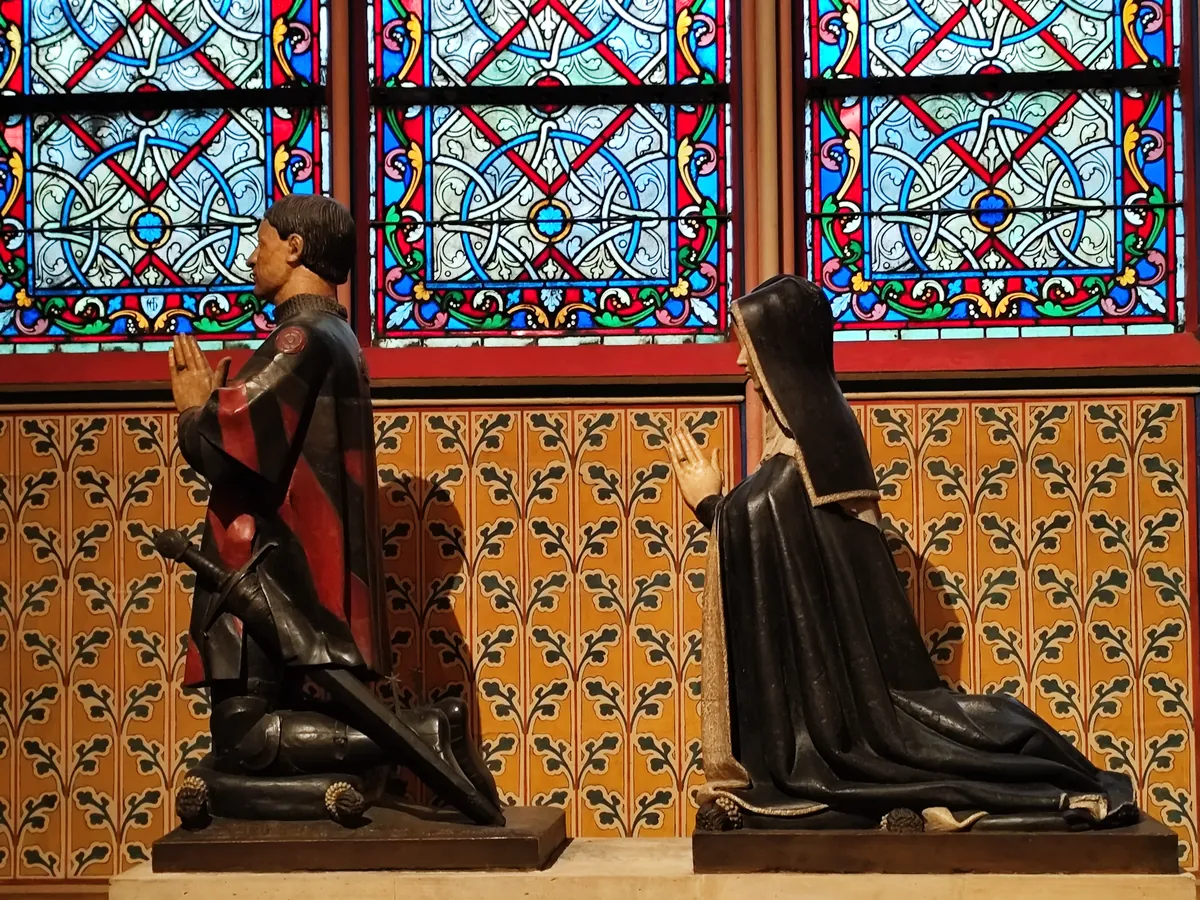
You might expect royal tombs in Paris's greatest church. There are none: French kings were buried at the Basilica of Saint-Denis, north of the city. Instead, here are the painted kneeling figures of Jean Juvénal des Ursins and his wife Michelle de Vitry — a lawyer from a family of cloth merchants, who died in 1431, and his widow, who outlived him by twenty years. Their son, also Jean, became Archbishop of Reims, crowned Louis XI and took part in the retrial that cleared Joan of Arc; that's how a merchant family won a place usually reserved for clergy. The statues have their own adventure: removed at the Revolution, they spent more than a century and a half in storage at Versailles and only came home to this chapel in 1955.
Where: heading back west along the south side of the ambulatory, with the choir screen on your right. The entrance to the Treasury (separate ticket) is on this side too.
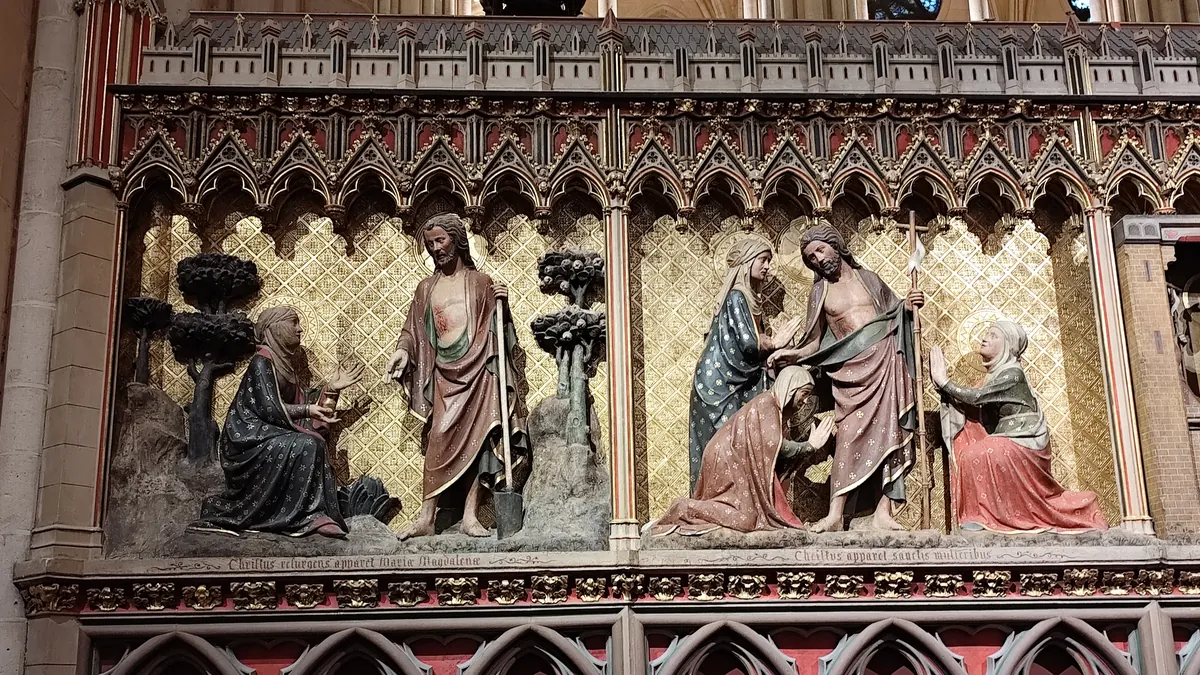
The screen on this side is younger and shows rarer subjects: Christ's appearances after the Resurrection — to Mary Magdalene in the garden, to Thomas, to the apostles. Through the gates into the choir you can see, at its far end above the old altar, a marble Pietà by Nicolas Coustou, flanked by two kneeling kings: Louis XIII, offering his crown to the Virgin, and his son Louis XIV.
Why them? Louis XIII and Anne of Austria had been married for more than twenty years without a son. In 1638 the king placed himself and all of France under the protection of the Virgin — and that September the long-awaited heir was born: the future Sun King. The vow promised a new altar for Notre-Dame; it was Louis XIV who finally paid for it, with this group at its heart. It's also why the feast of the Assumption on 15 August became such a national occasion in France — still a public holiday today.
Where: on the pillar at the south-east corner of the crossing, where the choir meets the south transept.
This slender 14th-century statue of the Virgin and Child is known simply as Notre-Dame de Paris — it shares the cathedral's name. It came from a small chapel elsewhere on the island and was moved here in 1818; in 2019 it stood just metres from where the burning spire crashed through the vault, and survived. Notice the lily in the Virgin's hand and the globe in the Child's.
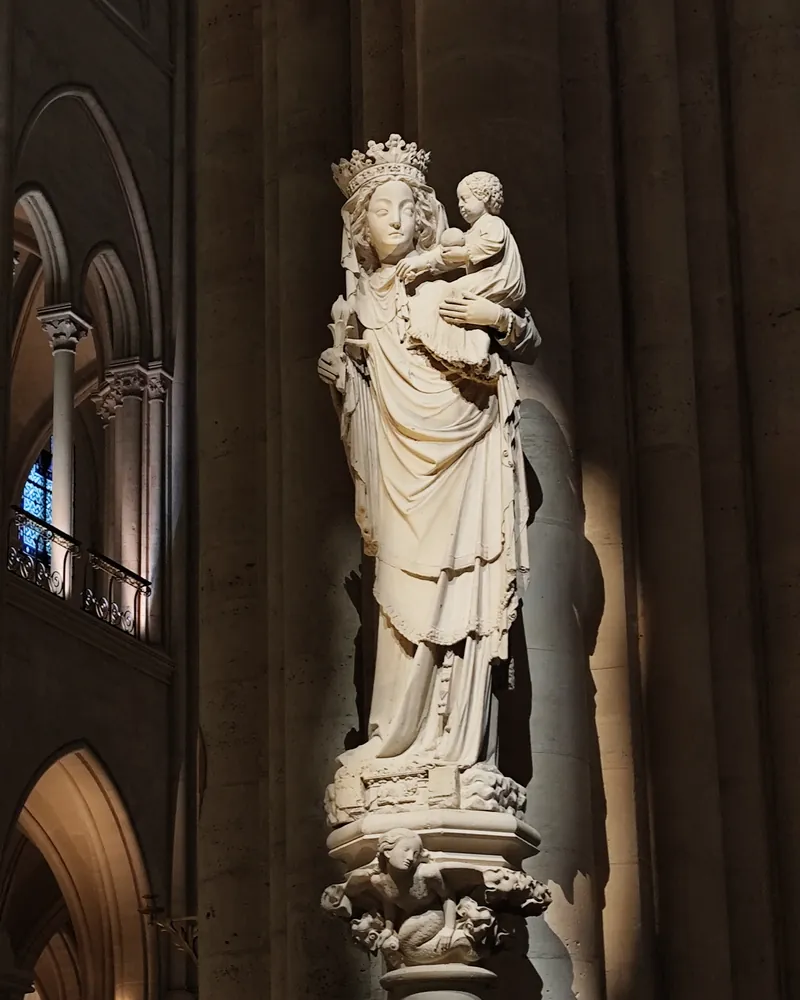
On Christmas Day 1886, an eighteen-year-old atheist named Paul Claudel stood near this pillar during vespers and, by his own account, was converted in an instant. He went on to become one of France's great Catholic writers. Approach with caution.
Where: in the south transept — look up.
The south rose, from around 1260, is the north rose's twin in size, with Christ at the centre surrounded by apostles, saints and angels. Facing the sun, it has suffered more over the centuries and was heavily restored, notably in the 19th century, but on a sunny afternoon it is the warmest window in the building, glowing red and violet across the transept floor.
Where: the route turns west along the south aisle towards the exit; the chapels are on your left.
Two things to look for here. The first is new: six stained-glass windows by the painter Claire Tabouret, replacing 19th-century grey glass in these chapels. Installation is scheduled for autumn 2026, with the unveiling planned for December — so if some chapels are screened off when you visit, that's why. The second is The Visitation by Jean Jouvenet (1716), the only one of the eight large paintings that once hung in the choir still at Notre-Dame.
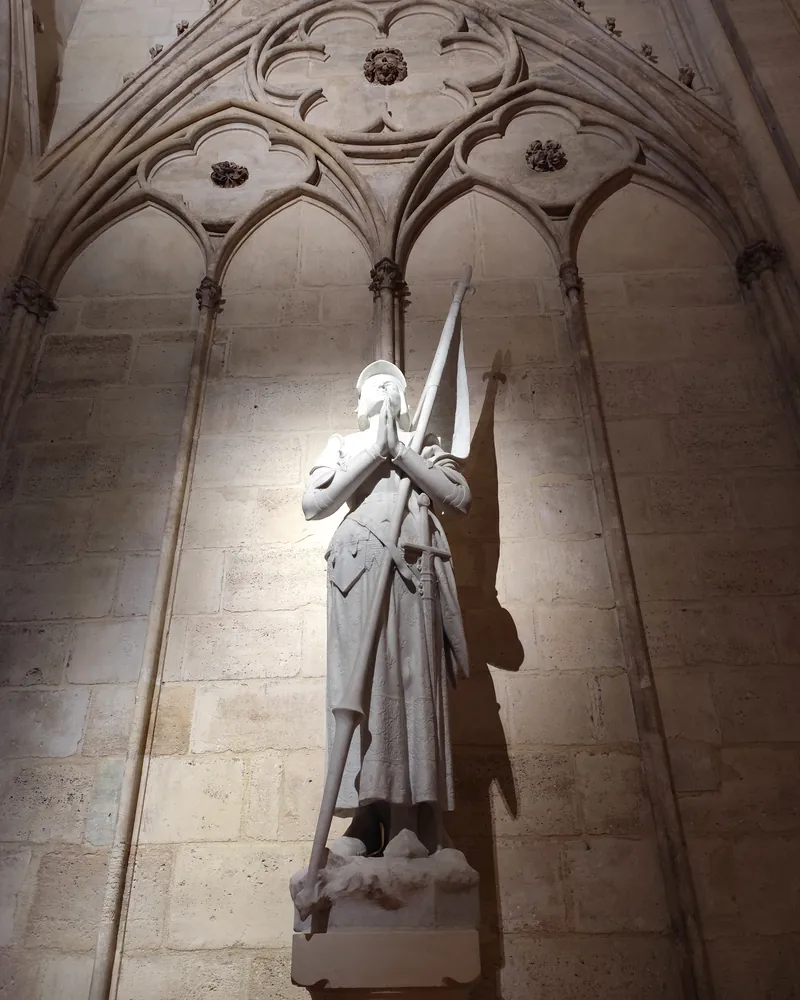
Where: the south-west corner, by the exit. Then turn round and look up above the doors you came in by.
The marble statue of Joan of Arc (Charles Desvergnes, inaugurated in 1921) closes a circle that began at stop 4. She was burned at the stake in Rouen in May 1431, aged nineteen — and that December the English crowned Henry VI king of France here at Notre-Dame. It didn't last: her victories had already turned the war, and France won it. A retrial cleared her 25 years later, and the Church made her a saint in 1920.
Above the west doors is the great organ, the largest in France: nearly 8,000 pipes and five keyboards, rebuilt in 1868 by Aristide Cavaillé-Coll. Louis Vierne, its organist for 37 years, died at the console in 1937 in the middle of a recital. In 2019 the organ escaped the flames but was coated in toxic lead dust; it was dismantled, cleaned pipe by pipe and reassembled, and it sounded again at the reopening. If your visit coincides with Mass or a recital, stay and listen.
Visitors generally find the mornings calmest, especially soon after opening; for the south rose, come in the afternoon — our best time to visit guide has the details. Keep your voice down: services take place throughout the day and Notre-Dame is first of all a working church. Photos are allowed, but not flash or tripods.
Small-group and private Notre-Dame tours — a good option if you'd rather ask questions in real time.
Is it free to go inside Notre-Dame?
Yes. Entry to the cathedral is free; a free timed reservation is optional. The Treasury, the towers and the archaeological crypt have separate tickets — see the tickets guide.
How long do you need inside?
A quick loop takes 20–30 minutes; to see the twelve stops in this guide properly, allow 60–90 minutes.
Can you go into the choir?
The choir is reserved for prayer. Visitors on the route walk round it in the ambulatory and see it over the screen and through the gates.
Where is the Crown of Thorns, and when can you see it?
Its reliquary is in the axial chapel behind the choir, on the visitor route (stop 6). The relic itself is shown on Fridays — according to the cathedral, on the first Friday of the month from 3 to 5 pm and on other Fridays from 3 to 6.30 pm. Check the cathedral's website before you go.
Did the fire destroy the inside of the cathedral?
No. The roof and spire burned, but the stone vault held. The rose windows, the great organ, the Pietà and the Virgin of Paris all survived. The full story is in the fire guide.
Is there an audio guide for the inside?
Yes. The TouringBee audio guide has 31 stops — 13 outside, so you can start while you wait, and 18 inside — in 10 languages, fully offline.
Stay a short walk from the Île de la Cité and you can be inside within minutes of opening, when the nave is at its quietest.
Notre-Dame's interior rewards the visitor who knows where to look. Take the stories with you: the audio guide starts on the square while you wait and continues at 18 stops inside.
Get the audio guide — €6.99Some links on this page are partner links (Booking.com, Tiqets, GetYourGuide). The price is the same for you; we may earn a small commission. The audio guide is provided by TouringBee.
